
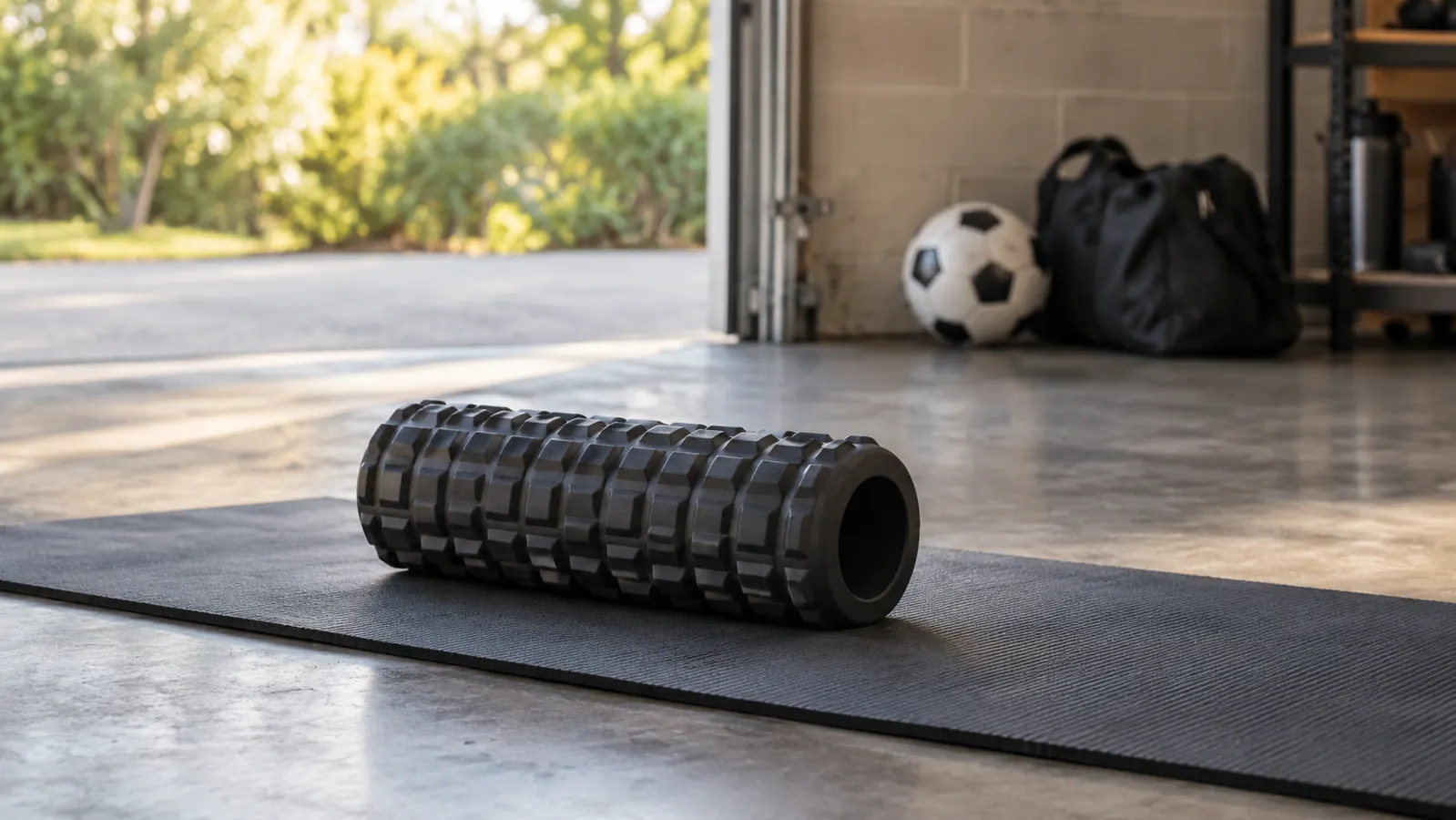
Three years ago I bought the 13 inch TRIGGERPOINT GRID 1.0 foam roller because my calves were so tight after Sunday league that I was walking to the truck like a much older man. I am 48. I play center midfield in an over-40 league on grass every Sunday morning and a 7-a-side pickup game on artificial turf every Wednesday night, and I have been doing both for about twenty years. Nothing dramatic happened when I started rolling. I did not have a moment. I just got tired of feeling stiff until Thursday.
This is the honest version of the review, which means it is mostly about limits. A foam roller is a 13 inch cylinder of firm foam with ridges and nodules molded into the surface, it weighs about a pound, and mine lives in the corner of my garage next to a yoga mat I use less than I should. After three years of weekly use I can tell you which parts of it held up, which parts of the marketing hold water, and which claims to ignore completely.
The Quick Verdict
Firm, ridged, and still round after three years of weekly use. It is not a soft roller, and it is not a fix for anything that actually hurts.
Amazon Check Today's Price →If your calves are still tight on Tuesday, this is where I would start
The 13 inch GRID 1.0 is the firm, ridged roller that has stayed in my garage for three years while everything around it wore out. Check today's price and the current listing on Amazon.
Amazon Check Today's Price on Amazon →What Nobody Tells You About the GRID
The first thing nobody tells you is that this thing is hard. The listing describes the foam as extra firm, and that is not modesty. It calls the surface a multi-density GRID with ridges and nodules, which sounds like catalog language until you lie on it and can feel exactly which parts of your back are touching the floor. If you have never used a roller before and you start with this one, your first session will be a surprise.
My previous roller was a plain smooth foam cylinder. It felt fine for about a season, then it went soft in the middle, then it went flat, and by the end I was rolling on something closer to a pool noodle. That is the tradeoff nobody mentions. Soft foam feels better on day one and stops doing anything by year two. Firm foam does the opposite, and it keeps doing it.
The second thing nobody tells you is that the shape does more work than the material. The ridges and nodules mean you are not pressing one flat line down your leg. When I roll a hamstring, the raised sections dig in and the recessed sections let up, so I get extra pressure on the tight spot without putting my whole body weight on it. On a smooth roller, pressure is the only variable and my only control is how much I lean. That difference is real and I did not expect it to matter as much as it does.
The third thing is that it does not replace anything. It does not replace a warm-up. It does not replace the lace-up brace I wear on my right ankle every single game. It does not replace the physical therapist I saw after I rolled that ankle badly about six years ago. If something actually hurts, rolling it is not the answer, and anybody who tells you otherwise is selling something. What the roller does is help me feel less locked up after a game. That is the whole claim I am making.
The density varies across the surface and you can feel which section you are on. TRIGGERPOINT calls these Distrodensity Zones, which is a trademark doing a lot of heavy lifting, but the idea underneath it is simple. The flatter sections are for broad pressure. The raised nodules are for one specific spot. In practice I use the flat sections on my quads and the raised sections on the knot just below my left calf, and that is the most useful thing about the design.
One more thing worth saying up front: this is not a medical device and I am not a physical therapist. I am an HVAC service technician in San Antonio who plays more soccer than is wise for a man my age. Everything below is what three years of owning one of these has been like for me, on my legs, in my garage.
My old smooth roller went flat inside a season. This one has taken three years of Sunday games and it is still round.
How I Actually Use It
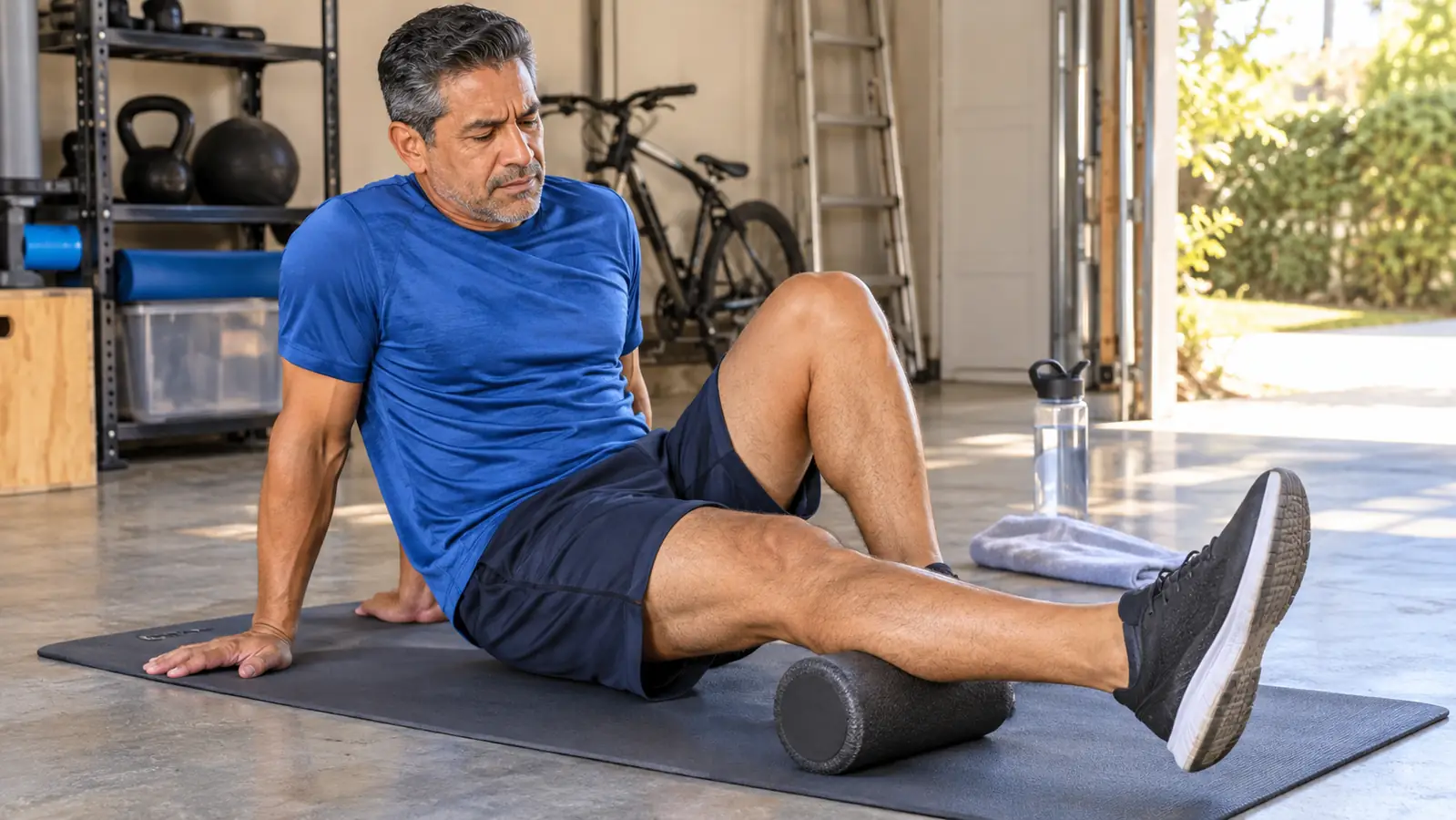
The whole routine takes about ten minutes. After a Sunday game I sit on the garage floor, put the roller under one calf, and work from the ankle up to the back of the knee, maybe ninety seconds a side. Then hamstrings, then quads, then a pass down the outside of each leg. Monday morning before work I do it again, because Monday morning is when I feel Sunday. Then it goes back in the corner until Wednesday.
That is not a program. It is a habit I can actually keep, which at 48 matters more than a routine I would abandon in three weeks. The roller is heavy enough that it stays where I put it instead of sliding across the concrete, and the surface grips my leg instead of skating off it. That grip is the reason I stopped using the smooth one. If recovery gear is annoying to use, I will not use it.
Wednesday night pickup is 7-a-side on artificial turf, and turf is harder on my calves than grass has ever been. The roller rides in the back of my work truck all week with my soccer bag, which means it sits in a closed cab through Texas summer afternoons. It has not warped, it has not gone soft at the ends, and the surface has not crumbled. Nobody designed it for that, but that is the test my gear gets.
One thing I would tell anybody starting out: go lighter than you think. The first month I had this, I rolled like I was trying to flatten a dent in a fender, and I was sore the next day in a way that had nothing to do with soccer. Backing off to about half the pressure fixed it. It still feels firm. It just stops feeling like punishment.
Do I Actually Notice a Difference?
Here is the honest test. I used a smooth roller for a season and this one for three years. The difference I can point to is not how it feels during the ten minutes. It is what the roller feels like in year two and year three. A soft roller quietly stops doing anything and you do not notice until you use a firm one again. That happened to me, and it is why I am not going back.
Where I notice it most is the outside of the leg. Rolling an IT band on a smooth roller is close to pointless for me, because the roller rolls off the moment I put any weight into it. The ridged surface holds its line and lets me work a strip that is otherwise hard to get to. It still is not comfortable. It is just finally useful.
What I cannot tell you is that it recovers me faster than stretching, a warm shower, or simply not playing three games in four days. I have no way to measure that and I am not going to pretend I do. It is ten minutes that makes Monday feel less like a penalty. That is the entire benefit and I am comfortable with it.
What I Liked
- Foam has stayed firm through three years of weekly use
- Ridged, multi-density surface reaches a tight spot that a smooth roller slides right over
- Grips the leg and the floor instead of skating away mid-roll
- About a pound, so it stays put, and it has survived three summers in a truck cab
- Wipe down with a damp rag and you are done, no other upkeep
Where It Falls Short
- Extra firm and unforgiving on bony spots, and my IT band argued with it for about a month
- Thirteen inches is short for rolling across the upper back
- Rigid and awkward enough that it never goes in the soccer bag, so it stays home
- The surface picks up garage dust and needs a monthly wipe
- One firmness only, so a genuinely wrecked-leg day is not its day
The Part That Wore Out and the Part That Didn't
After three years of weekly use, the TRIGGERPOINT roller has held up better than anything else in my gear. The ridges are still there. The foam has not gone soft in the middle. The ends have not crumbled, which is exactly how my old smooth roller died. I wipe it down with a damp rag and that is the whole maintenance history.
What wore out was everything around the habit. The yoga mat under it is not the mat I started with. Two pairs of work pants gave out at the knees from kneeling on concrete. My ankle brace is on its second one after the first lasted about three years. The roller looks like the day it came out of the box, minus some dust.
The honest complaint list is short and mostly about design rather than durability. Thirteen inches is a good length for calves and hamstrings and a bad length for anything across the body. If you want to roll your upper back or lie on it along your spine, the short length makes you work to stay balanced and a longer roller would be easier. It is also firm enough that bony spots complain. My IT band took about a month to stop arguing with it.
And it is one piece of foam. That is all it is. There is a corner of the internet that will describe a foam roller as a recovery system. It is a firm cylinder you lie on. That is not a criticism, it is just the accurate description.
The Small Annoyances
The foam picks up garage dust and concrete grit, and once that is on the surface it ends up on your leg and then on your hands. I wipe mine with a damp rag about once a month. Twenty seconds, and it is the only upkeep it has ever needed.
It is also one firmness, full stop. On a day when my legs are genuinely wrecked, this is the wrong tool and I roll for two minutes and stop. A softer roller would let me stay on it longer. That is a real tradeoff and I would still rather have the firm one for the ninety percent of days that are normal.
There is a noise thing too. Rolling on concrete in a garage at six in the morning makes a hollow sound that carries into the house. My wife Marisol has mentioned it more than once. That is not the roller's fault, but if you plan to roll on a hard floor in a quiet house, you will hear it.
How It Fits With the Rest of My Gear
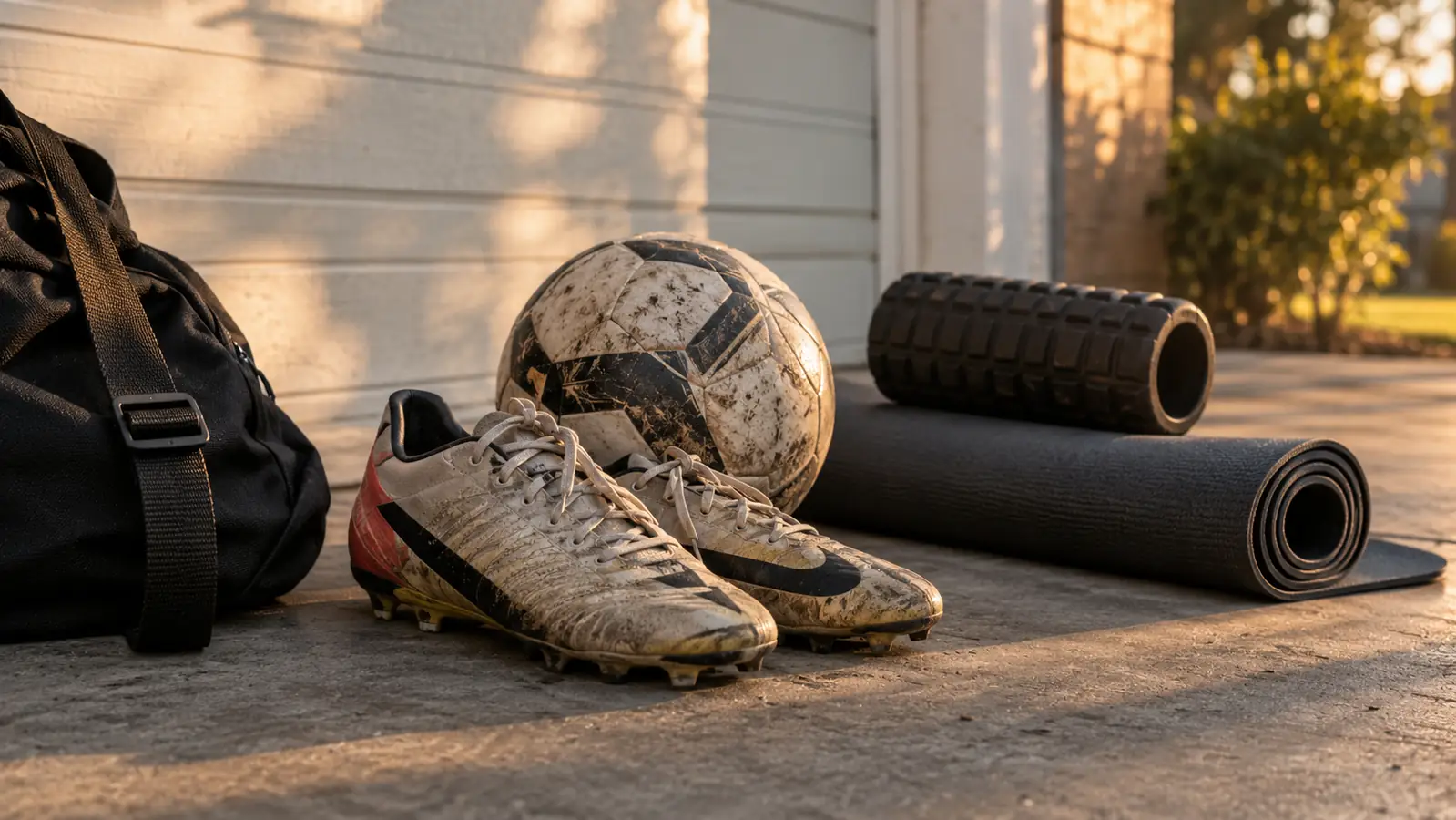
My gear bag is a black backpack-style soccer bag that lives in the truck. The roller does not go in it. It rides loose in the cab or the bed, because it is thirteen inches and rigid and there is no pocket that wants it. That is fine, but it means this is a garage object, not a bag object. If you want something to carry to the field, this is bigger and more awkward than the product photos suggest.
It sits next to the yoga mat. The shin guards, the ankle brace, the calf sleeves and the grip socks all live in the bag. The roller lives on the floor. That split tells you what kind of tool it is. It is not part of getting dressed for a game. It is part of the ten minutes after.
What It Doesn't Do
It does not make a tight hamstring permanently loose. I have rolled my hamstrings for three years and they are still tight. They are less tight on Monday than they used to be, and I will take that. What helped more was a proper warm-up and being honest about how many games I play in a week.
It does not fix a bad ankle. My right ankle is why I wear a lace-up brace for every game and why I saw a physical therapist before I went back to playing at all. Rolling the outside of my leg did not change that and was never going to.
It does not replace sleep, water, or not playing three games in four days. At my age that last one is the lesson I keep relearning. The roller helps me feel better. It does not help me get away with something my body is not going to allow.
Who This Is For
Recreational players who show up every week. If you play once or twice a week and you are old enough to feel it on Monday, this is the kind of thing that earns its spot in the garage. It is also the obvious next step if you have already had a cheap smooth roller go soft on you, because you know exactly what the upgrade buys.
It also suits players who have one specific spot that bothers them. Mine is a knot just below the left calf. The raised sections get to it in a way a flat roller never did, and that is worth more to me than any of the broader claims on the box.
And it suits people who like a firm surface. I do. If you want something gentle, this is the wrong roller and you will know within about four seconds of the first pass.
Who Should Skip It
If you have never used a roller, start with something softer. I am not being modest, I am telling you that starting on an extra firm ridged surface is a good way to decide you hate rolling, and rolling is more useful as a habit than as a test of will.
If you have actual pain, skip the roller and go see someone. A doctor or a physical therapist can tell you what is going on. A cylinder of foam cannot, and no review, including this one, should talk you out of getting it looked at.
And if you want one tool that covers your whole body comfortably, including your upper back, thirteen inches will frustrate you. Look at a longer roller for that job and keep this one for legs.
Three years in, this is still the piece of recovery gear I would replace first if it disappeared. Not because it does something dramatic, but because it does a small thing reliably, every week, and it has not worn out while everything around it has. For a weekend player in his late forties, reliable is the whole game.
The roller I would buy again, three years later
Thirteen inches, extra firm, still round after three seasons of Sunday games and Wednesday turf. If you are a weekend player who feels Sunday on Monday, this is the one I would start with. Anything that actually hurts, see a doctor or a physical therapist first.
Amazon Check Today's Price on Amazon →