
Sunday morning, about 9:40, second half, and I push off for a ball I have no business chasing at 48. My right hamstring tells me no. Not a pop, not a tear, just that heavy, shortened feeling that shows up when I have spent 90 minutes asking my legs for something they stopped handing out free a decade ago. I play center midfield in an over-40 league in San Antonio, grass fields at a city park on Sunday mornings, plus a 7-a-side pickup game on artificial turf on Wednesday nights. Tight hamstrings and tight calves are the two things I have to stay on top of all week, or the whole week feels off, including the part where I climb ladders for a living.
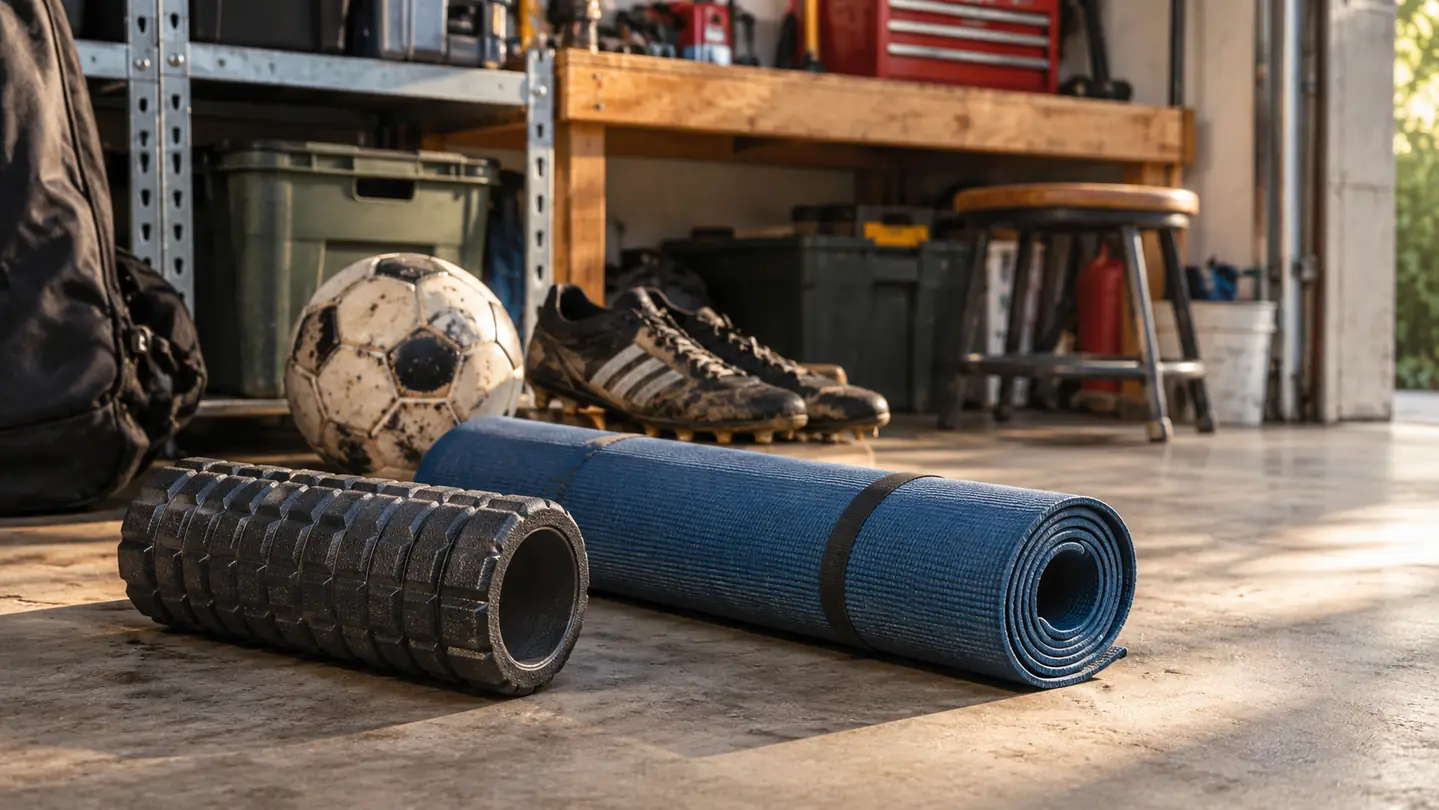
I am not a physical therapist and I am not going to pretend a foam roller fixes anything. What I can tell you is the routine I actually do in my garage after a game, in the order I do it, on the TRIGGERPOINT GRID 1.0 I bought about three years ago. It is a 13 inch roller, extra firm foam, with a multi-density grid surface instead of a smooth shell. Mine lives in the corner of the garage next to a yoga mat and has outlasted two pairs of cleats. Sunday it gets about ten minutes. Monday morning before work, it gets five.
The roller I reach for before I even get out of my kit
TRIGGERPOINT GRID 1.0, 13 inches, extra firm foam with a multi-density grid surface. Three years of twice a week use and mine still has not gone soft.
Amazon See the GRID 1.0 on Amazon →The Routine, In Order
Step 1: Walk it off and get some water in you before you roll
The first thing I do after the final whistle is not roll. It is walk. One slow lap around the field, a bottle of water, change out of the cleats, then the drive home with the windows down because I am still a sweaty mess. By the time I am in the garage it has been 20 to 30 minutes since the game ended, and that is when I get on the floor.
I did it the other way for years. Roller out of the truck at the field, straight onto the grass, working a hamstring while my whole body was still out of breath. I would feel virtuous about it, drive home, and then sit down at the kitchen table with a leg that felt tighter than when I started. It took me most of a season to admit that. Rolling after I have cooled off and had some water is the version where I actually notice a difference the next morning.
Wednesday pickup is a little different because it is a 10 minute drive home. I still walk a few minutes first and still drink something, but I am on the roller sooner than I am on a Sunday. That turf is unforgiving and my calves know it by Thursday. Skip the Wednesday roll and Thursday at work is me crouching carefully next to a condenser unit instead of just doing my job.
Step 2: Set the roller under the hamstring, not behind the knee
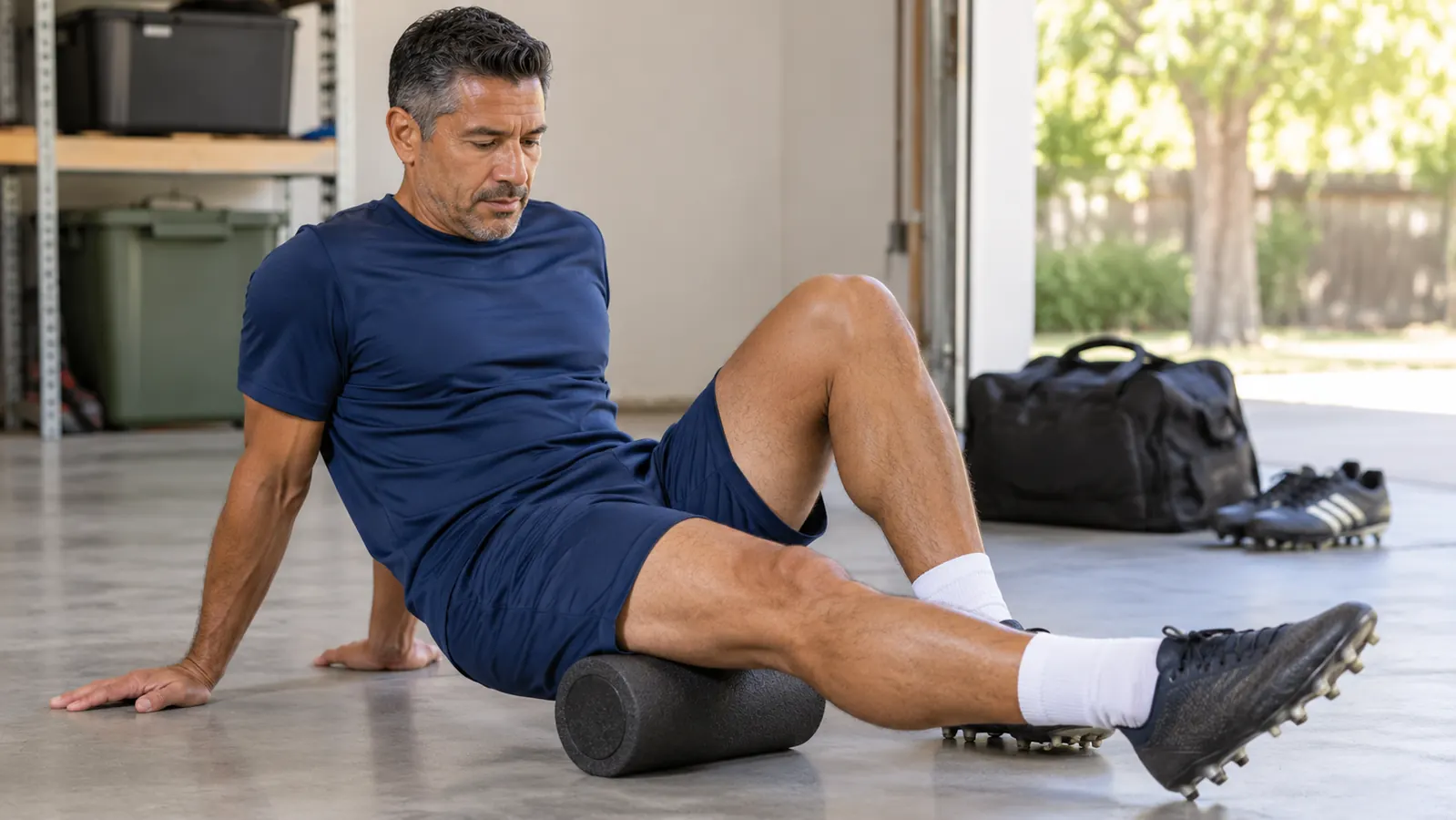
Sit on the floor with the roller under the back of one thigh, that leg mostly straight, the other foot flat on the floor with the knee bent. Lean back on your hands and lift your hips just enough that the pressure comes off the floor and onto the roller and the back of your leg. On the GRID that takes a few seconds to get right, because the surface is not flat and you will feel it find different spots as you shift your weight around.
The 13 inch length matters more than I expected. It is short enough that it stays under one leg without wandering sideways, and long enough that I am not chasing it back into place every ten seconds. A longer roller sounds nice until you are trying to keep it on one hamstring in a garage with a work truck parked in it. At a hair over a pound, the TRIGGERPOINT roller is also easy to drag out of the corner with one hand while I am still in my kit.
Stay out of the back of the knee. The tissue there is soft and the roller just digs into it in a way that is uncomfortable without doing anything useful for me. I keep the pressure on the meat of the hamstring, from a couple of inches above the knee to just below the glute. The first week I owned the roller I got that wrong and spent an evening with a spot behind the knee that ached for no good reason.
Step 3: Roll slowly, about an inch a second
Slow is the whole thing. I move roughly an inch per second, which sounds ridiculous until you try it and realize how fast you were going before. Eight to ten passes down the length of the hamstring, then start again near the knee.
This is the second reason the TRIGGERPOINT roller earns the corner of my garage. The multi-density grid has varying ridges and nodules across the surface, so at a slow pace you can feel where it is working and where it is skating over. I timed myself once out of curiosity, phone stopwatch on the floor next to me, and one full pass took about 25 seconds. That is four minutes a leg for ten passes, which is the whole hamstring portion of the routine and worth doing properly.
I breathe out on the way down the leg. Sounds like a small thing. It is the difference between me tensing up against the roller and me actually letting the leg relax into it.
Three years, two games a week, and the grid surface has not gone flat. That is the only reason I stopped buying the soft ones.
Step 4: Stop on the tight spot and bend the knee slowly
You will find a spot. Mine is a few inches below the glute on the right leg, and it has been the same spot for years. The left leg has its own, lower down and closer to the knee, and it is milder. When you find yours, stop moving and park there. Twenty to thirty seconds of steady pressure, no rolling. Then bend the knee slowly a few times while you stay on the spot, which changes the angle the roller hits and gets at the tissue from a slightly different direction.
I count breaths instead of seconds, four or five slow ones, because counting to thirty in my head makes me rush. I have tried the clock and I always cheat somewhere around twenty two. On a scale of one to ten I keep the pressure around a five or a six. If I am gritting my teeth, that is not useful pressure, that is just me hurting myself in my own garage.
If a spot is sharper than that, or if it feels bruised the next morning, I leave it alone for a few days. Tight is one thing. Tender in a way that lingers is a different conversation, and it is not one I settle with a piece of foam.
Step 5: Finish with a 30 second stretch and repeat the next morning
After the rolling I stretch. One simple hamstring stretch, 30 seconds a side, no bouncing. I put a foot on the bumper of the truck, keep my back flat, and lean forward until I feel it, then hold. If I am honest, the roller alone leaves me feeling loose but not long, and the stretch is the part that makes the difference for me. That is the whole thing. I am not doing a yoga class in the garage at 11 in the morning.
Then Monday morning, before work, I am back on the roller for about five minutes. Not the full routine, just the hamstrings and the calves while the coffee is going. Monday is the day my legs feel the Sunday game the most, and five minutes on the floor before I load the truck makes the first two service calls of the day a lot less stiff, especially the one where I am up and down a ladder.
Twice a week plus a Monday morning is what has kept me playing at 48. Not one heroic session the night before the season starts. The boring version, done every week, is the one that works for me.
What Else Helps
The roller is the main thing, but it is not the only thing I do. My calves get just as tight as the hamstrings, especially on the Wednesday turf game, which is why I wear Rymora calf compression sleeves for warm-up and the game and sometimes for the drive home. That is a separate job from the TRIGGERPOINT roller. The sleeves support the calf during play, the roller is what I do afterward.
Warm-up matters more than I used to admit. Eight to ten minutes before kickoff: a slow lap of the field, ten leg swings each side, a set of walking lunges I do badly, then four or five build-up runs from the touchline to the halfway line at increasing pace. Nothing fancy. I skipped that for years and the first ten minutes of every game were my worst ten minutes. Now I start with legs that are awake instead of legs that are still in traffic on I-10.
The other piece is strength work. Twice a week I do a couple of hamstring exercises a physical therapist showed me, the slow, controlled kind that are boring enough that I do them while the game is on TV. One is a slow curl with my feet under the couch, the other is a single leg deadlift with no weight at all. That is not a foam roller job and I am not going to pretend it is. The roller helps me feel looser and gets me moving again. The strength work is what I do so the same tightness does not show up every single week.
One thing worth saying out loud: the tools in my bag do different jobs. The ASO brace is for my right ankle after the sprain years ago. The shin guards are for shins. The Rymora sleeves are for calves. The GRID roller is the one that handles the legs after the game. I have mixed those up in my own head before and it does not help anybody.
If you are deciding between this roller and a plain smooth one, I had a smooth roller before this and it went soft in the middle within a year. I wrote that comparison up separately, and there is a longer term review of the GRID 1.0 if you want the three year version instead of the short one.

When It Is Not Just Tightness
There is a difference between a hamstring that is tight and a hamstring that is hurt. A pull you felt when it happened, bruising, weakness when you try to push off, pain that wakes you up, or pain that shoots down the leg is not a rolling problem. Rolling a strained hamstring is a good way to make it worse. That is a doctor or a physical therapist, not a foam roller and not a guy on a Sunday league team writing about his garage.
Same goes for anything that has been nagging for more than a couple of weeks without improving. I say that as someone who ignored a tight calf for a month before finally asking somebody about it. The answer was not complicated. I just needed to hear it from a person with a license instead of my own stubborn self.
One roller, ten minutes, twice a week
The GRID 1.0 is not going to make you 25 again. It is the thing I use so my legs feel like mine on Monday morning instead of somebody else's.
Amazon Check availability on Amazon →