

I have worn a Med Spec ASO Ankle Stabilizer on my right ankle for every game I have played in the last six years. That is not a recommendation, it is just the fact I have to start with. About six years ago I rolled that ankle badly near the end of a Sunday morning match and spent the next several weeks on the couch learning how much of my mood depends on playing. My physical therapist suggested a lace-up brace when I got back to running, so I bought one, and I have laced up before every match since. I am on my second one now. The first gave out after about three years of weekly use.
What follows is what I know as a player, not as anyone with a medical opinion. I am 48. I work as an HVAC service technician in San Antonio, Texas, I play center midfield in an over-40 league on Sunday mornings on grass, and I play 7-a-side pickup on artificial turf on Wednesday nights. If your ankle hurts right now, book an appointment with a doctor or a physical therapist and let them do their job. I mean that plainly. What I can tell you honestly is what this brace feels like inside a cleat for ninety minutes, which parts of it fail first, and whether the lacing is worth it for a weekend player.
The Quick Verdict
A well-built lace-up that has held my right ankle through six years of weekend soccer. It is not a fix for anything and the laces are a chore, but I keep putting it on before every game.
Amazon Check Today's Price →The brace I lace up before every game, with the size chart on the listing
I wear a Large. Fit around the ankle and instep matters more than shoe size, so check the chart before you order.
Amazon Check Today's Price on Amazon →How I Actually Use It
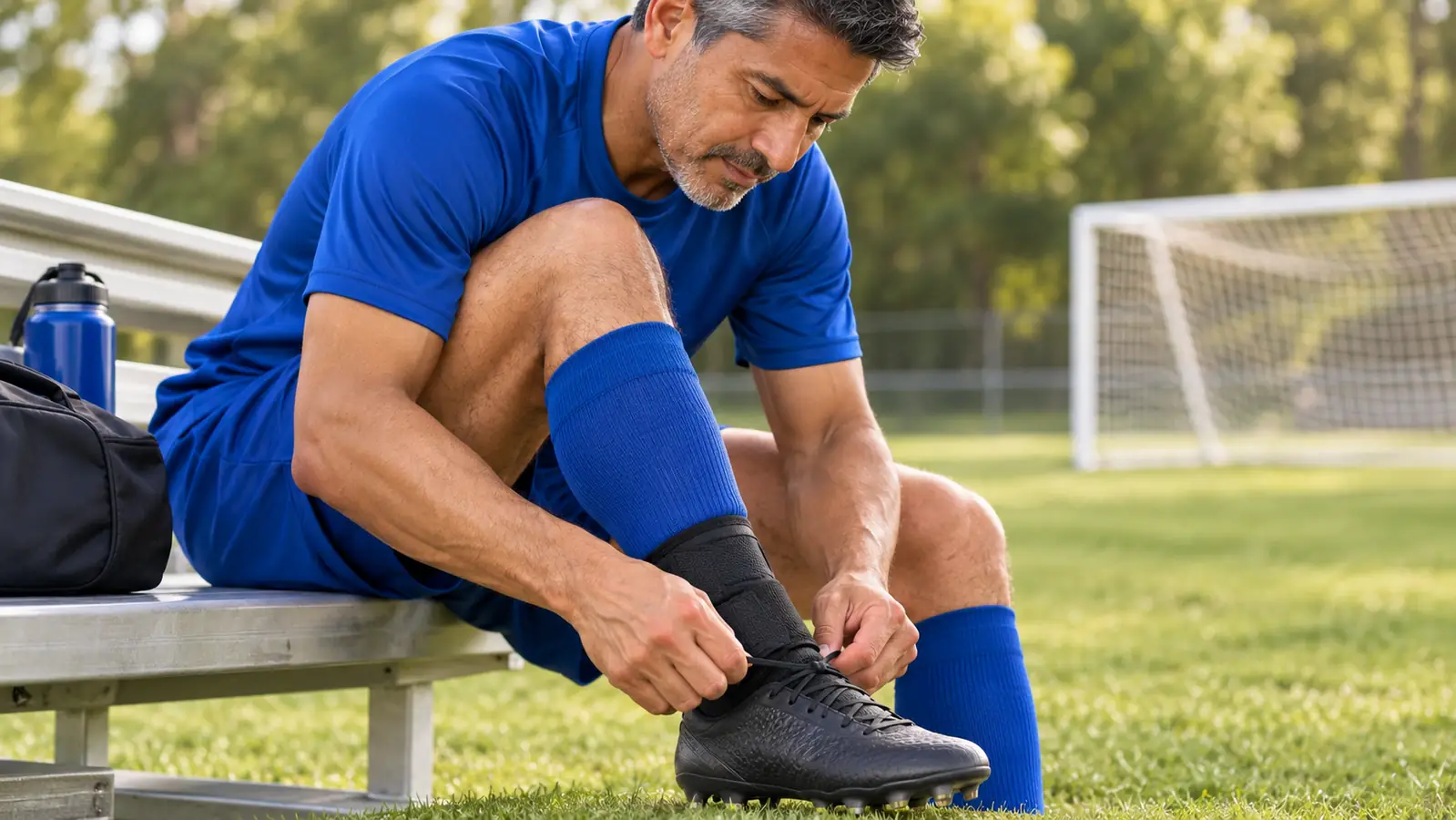
I brace the right ankle only. The left one has never given me trouble and I am not going to wrap a healthy joint out of superstition. The routine never changes: thin sock, brace over it, lace it up, team sock pulled over the whole thing, then the cleat. People ask me most often whether it fits inside a normal soccer shoe. It does. I wear a standard low-cut grass cleat and I did not have to size up, though the shoe does feel snugger across the top of my foot with the brace on.
The first Sunday I wore it I spent the whole warm-up convinced I would notice it for ninety minutes. By the second half I had stopped thinking about it entirely, which is the highest compliment I can pay a piece of gear. What surprised me is the way it holds. I expected something rigid and locked. Instead the figure-8 straps that cross over the front of the ankle make it feel like the joint is being gathered and held rather than clamped. When I plant and turn on that foot, it feels supported. Whether it has kept me out of trouble is not something I can prove and I am not going to pretend otherwise.
The Wednesday turf game is the harder test. Turf grabs at your foot, the surface is quicker, and it is less forgiving of a bad landing. I still wear the brace for it. The nylon does not add much bulk, which is the one thing the listing gets right when it calls it lightweight. My cleat is not loose anywhere else and I do not feel like I am playing in a boot. On grass I sometimes forget the brace is under the sock until I catch sight of the extra lacing above the tongue.
There is one match I keep coming back to when people ask me if the thing actually does anything. Late October, a cold front had come through the night before and the park field was slick on top with the grass still wet underneath. Twenty minutes in, a ball got played into my feet with my back to a defender, and I did what I have done ten thousand times: planted the right foot and turned. On that surface the cleat slipped a half step. I felt the ankle gather in the straps instead of rolling over, caught my balance, and played the ball square. Maybe I stay upright without the brace. Maybe I do not. That is the honest answer, and it is also the reason I have never once forgotten to put it on since.
I am on my second one. The first Med Spec brace lasted roughly three years of weekly games, plus a couple of summers of the turf night. Nothing tore. The straps just stopped feeling crisp, the nylon softened, and one day it felt like I was wearing a thick sock instead of support. That is the honest life of a nylon brace you sweat into twice a week. The listing gives a six month limited warranty, which is a fair signal of what the manufacturer expects. Mine went well past that, and I did not try to claim anything on it.
What Nobody Tells You Before You Buy
Sizing is the part people get wrong, including me. The brace comes in a range of sizes and I wear a Large. Ordering by shoe size alone is a mistake, because what has to fit is the ankle and the instep, not the length of your foot. My first one, bought in a hurry, was not quite right and it bunched across the front of my ankle every time I laced it. The correct size sits flat. If you are between sizes, I would not gamble on the smaller one.
It changes how your cleat fits, and not in a way you can predict from a photo. The upper of the shoe sits a little higher and tighter over the laces. For the first week it felt odd enough that I noticed it every time I put the shoe on. By the second week I had stopped noticing. If your cleats are already tight across the instep, try the brace on with them before you commit to a season.
You will re-tie it. Laces loosen when you run, and this brace has more lacing than a shoe does. I tug both ends at halftime and sometimes at a stoppage if we get one. That is thirty seconds, not a crisis, but nobody mentions it when they hand you a brace and tell you it is comfortable.
When the first one finally went soft I did not just reorder the same size and hope. I sat at the kitchen table on a Tuesday night with a cloth tape measure and measured around my ankle and across the instep, wrote the two numbers on the back of an envelope, and had Marisol read the size chart off my phone while I held the tape. Then I checked it against the fit of the old brace, which by that point was loose enough to slide on with no lacing at all, so I was really measuring my ankle and not the worn-out nylon. The new one arrived, I laced it up in the garage with my cleat on, walked around the driveway for a few minutes, and it sat flat from the first try. That is twenty minutes of fuss to get three years of use out of it. Worth doing once.
Three years of weekly games works out to roughly 150 matches before the nylon stops feeling like support. That is the number I plan around, not the six month warranty.
The Parts That Genuinely Annoy Me
You cannot put it on standing up in the parking lot. This is a sit-down job. I get to the field early, sit on the tailgate of my truck, and work through sock, brace, laces, team sock, cleat. It adds maybe two or three minutes to my pregame. On a cold morning that is fine, since I want the extra time to warm up anyway. On the day I am running late from a service call, it is exactly the delay I do not want.
It gets warm. Nylon against a sock, inside a shoe, in a Texas September, is not a cool place to be. After a match my right ankle and foot are noticeably damper than my left. I rinse the brace in the sink when I get home, wring it out, and hang it on the side of my gear bag to air dry. That is my habit, not something the listing tells you to do, and it has kept the thing from turning unpleasant.
The lace ends fray long before anything else fails. They are thin, and they get pulled tight twice a week. When they start to look fuzzy I trim them and melt the tip with a lighter, which is a trick I picked up from a hockey guy at the pickup game. If you skip that, you will eventually be threading a frayed end through an eyelet in the dark while your team is already warming up.
The worst one was a Sunday in early September, first game of the fall season, temperature already in the mid nineties at nine in the morning and no shade on that side of the park. I finished the match, sat on the tailgate, pulled the cleat and the team sock off, and the brace came off warm and heavy like it had been through a wash cycle. I drove home with it hanging off the strap of my gear bag on the passenger seat, rinsed it in the laundry sink, wrung it out twice, and set it on the lip of the garage shelf with a box fan pointed at it. It was dry by the next morning. That routine has not changed in six years, and it is the difference between a brace that lasts three years and one that starts to smell like a locker room by August.
What Wore Out First, and What I Check Now
On the first brace, the straps stretched before anything else. The laces held, the stitching held, the nylon stayed in one piece. But the figure-8 straps gradually lost their snap, and that snap is the whole point of them. When I bought the second one I paid attention to how firm the straps felt out of the box. That is the thing I check now: if the straps go soft, the brace is finished, no matter how good the rest of it looks.
The second thing I watch is the seam along the top edge. That edge rubs against the tongue of my cleat for ninety minutes and it takes the most wear. Mine has held up so far. When it starts to separate I will replace the brace rather than tape it, because a brace coming apart inside a shoe is a distraction I do not need at my age in an over-40 league.
Here is the test I now run on a new one, and it takes about a week. I lace it up at home with the cleat on and walk around, then I pull the straps snug and let go. A good one holds its shape and the tension stays where I put it. A tired one relaxes the moment I let go, which is exactly what the old brace was doing in its last six months. I also check that the lacing runs evenly through the eyelets and that nothing puckers at the front of the ankle when it is tight. If it puckers on the first try, it is going to rub by the second week. That is not a knock on the brace so much as a reason to get the size right.

What It Does Not Do
It does not make my ankle new. I still warm up carefully, I still stretch my calves, and I still know which direction I do not want to land in. The brace is a piece of nylon I put on before kickoff, not a shield. Anyone who tells you a brace means you can stop paying attention is selling you something, and I am not.
It also does not replace the work my physical therapist gave me after the sprain. That was weeks of boring exercises, and it is the reason I am playing at all. The brace came after the rehab, not instead of it. That order matters more than anything else in this review, and it is the thing I would say first if a teammate asked me in the parking lot.
How It Compares to a Slip-On Sleeve
A teammate lent me a sleeve-style support for about a month of Wednesday pickup. It was quicker to put on, it was comfortable, and it felt like a warm hug around the ankle. It did not feel like support to me. I went back to the lace-up for the turf game, where I want the ankle gathered and held rather than gently squeezed. For someone who wants something they can pull on in ten seconds and forget about, a sleeve is the honest answer. For me, the lacing is the trade I make.
There are cheaper lace-ups and stiffer ones. I have not worn them long enough to say anything useful about them, and I am not going to guess. What I can say is that Med Spec has been making this style for a long time, the design has barely changed in the years I have been wearing it, and that consistency is worth something when you replace a piece of gear every few years. I do not want to relearn a brace at 48.
What I Liked
- Laces up snug and stays put inside a standard low-cut cleat
- Figure-8 straps feel supportive without a rigid, locked sensation
- Nylon and stitching held up for about three years of weekly play
- Lightweight enough that I forget it is on during a match
- Six month limited warranty from the manufacturer
- Sized to fit the ankle and instep, which is what actually matters
Where It Falls Short
- Two or three minutes to put on, and you have to sit down for it
- Laces loosen during play and need a tug at halftime
- Nylon gets warm and damp inside a cleat in summer heat
- Lace ends fray long before the rest of the brace wears out
- Sizing is not forgiving if you guess
Who This Is For
This is for the weekend player who has already been through the injury and the rehab, who has been cleared to play, and who wants something that feels substantial inside a cleat. It suits someone who does not mind a short routine before kickoff and who plays once or twice a week on grass or turf. If you are the sort of player who arrives eight minutes before the whistle and pulls your boots on at the bench, you will either change your arrival time or you will quietly stop wearing it. It is also a reasonable thing for a parent to buy for a teenager playing school soccer, as long as a doctor or athletic trainer has signed off on the plan first.
Who Should Skip It
Skip it if you want something you can pull on and forget about. Skip it if your cleats are already tight across the instep, unless you are willing to change shoes. Skip it if what you actually need is a diagnosis, because a brace is not one and I am not the person to give you one. And skip it if you are looking for a reason to avoid the boring rehab work, since for me the brace is what I put on after the rehab, not instead of it.
My second one in six years, and I would buy a third
If you rolled an ankle and you want to keep playing weekend soccer, this is the piece of gear I would replace first if it went missing from my bag. Check the size chart on the listing before you order.
Amazon Check Today's Price on Amazon →