

Six years ago I planted my right foot to turn on a wet grass field, the ankle kept going, and I heard the sound a rolled ankle makes. I did the rehab, the physical therapist cleared me, and then I asked her the only question I actually cared about: what do I wear when I go back out there? She suggested a lace-up brace. I bought a Med Spec ASO Ankle Stabilizer that week. I am on my second one now, and it has been on my right ankle for every Sunday league game since, plus most of the Wednesday night pickup games on turf.
This is not a review from someone who tried a brace for a weekend and wrote it up. It is a review from a 48-year-old center midfielder in an over-40 league in San Antonio who has played adult ball for about 20 years and intends to keep playing into his 60s. I have washed this thing, forgotten it in the truck, stuffed it into a cleat in a parking lot, and worn it through two Texas summers. Here is what held up, what wore out, and who I think it is actually for.
The Quick Verdict
The brace I keep coming back to. It fits inside a cleat, it survives weekly washings, and it lets me play without thinking about my ankle. Expect to replace it every few years when the straps give out.
Amazon Check Today's Price →The brace that has been on my right ankle for six years
Lace-up nylon with figure-8 straps, sized to fit inside a cleat. Check today's price and the available sizes on Amazon.
Amazon Check Today's Price on Amazon →How I've Used It
I wear it on the right ankle only. The left one is fine, and I am not going to brace something that does not need bracing. The routine is the same every week: I put it on at the house before I leave, over a thin sock, and I drive to the field with it already on. Trying to lace and strap a brace in a parking lot with cold hands is a waste of the ten minutes I could spend warming up, and I have learned that lesson more than once.
On the field it goes inside my cleat. That is the part teammates ask me about most, because a lot of braces are too bulky to fit in a shoe at all. This one does fit, but it is not invisible. I go up half a size in cleats and I leave the laces on that foot a little looser. If you insist on a snug cleat, the brace will make it feel tighter, and that is a fit problem, not a brace problem.
After the game I take it off, let it air out on the drive home, and throw it in with the rest of the wash on Sunday afternoon. I do not baby it. It has been through the machine dozens of times and I always let it air dry rather than putting it in the dryer. The nylon body has held up better than I expected. The velcro on the straps is the part that eventually goes, and it went on the first one after about three years of weekly use.
One thing I did not expect: the brace made me a better warmer-up. Because I have to spend two minutes putting it on, I now spend the ten minutes before that actually moving instead of standing around talking. That is not a feature of the product, that is a side effect of owning it, but it has probably done as much for me as the brace itself.
What You Get and How It Goes On
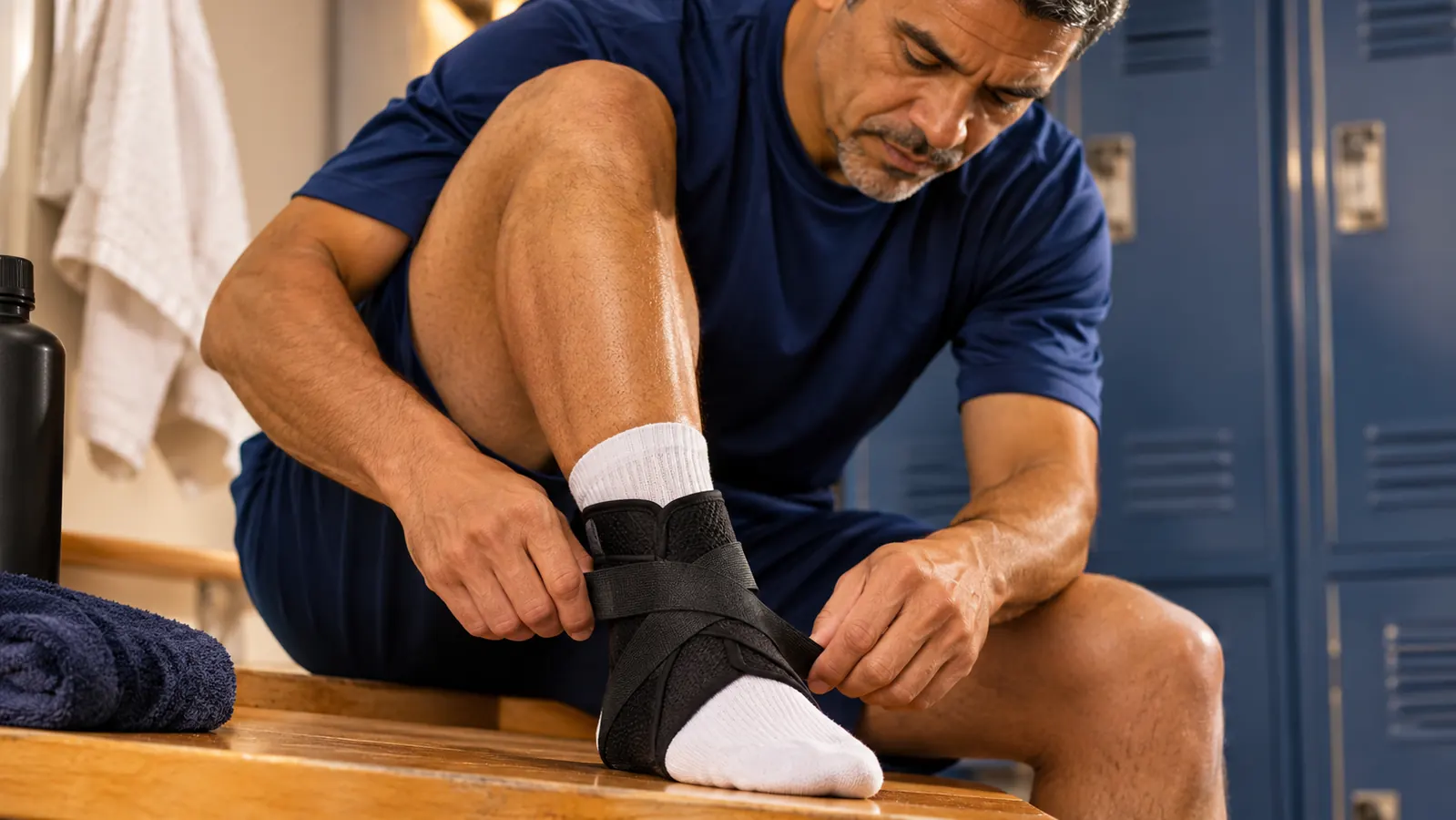
The ASO is a lace-up brace. Nylon body, laces up the front, and two figure-8 straps that wrap around the ankle and close with velcro. There is a stirrup shape to it that cradles the ankle on both sides. Med Spec lists it as lightweight, and relative to a hard-shell brace it is. The size Large is what fits me, and the sizing chart is worth reading twice, because a brace that is too small will not close correctly and one that is too big will slide around inside your shoe.
The order you put it on matters more than I expected. Sock first. Then the brace, laces snug but not tourniquet tight, then the figure-8 straps pulled across the front of the ankle and fastened down. The straps are the whole point. The laces hold the brace against your foot. The straps are what give you the side-to-side support. If you skip the straps or leave them loose, you are wearing an expensive sock.
It takes me about two minutes, and I have done it a few hundred times. The first month it took closer to five, and I got it wrong in both directions, first too loose to do anything, then so tight my toes went numb by halftime. The right tightness is the point where you can feel it holding without feeling your pulse in your foot.
The Figure-8 Straps Are the Reason I Still Wear It
Here is what I noticed in the first month and still notice six years later. When I plant and turn, my ankle feels held. Not locked, held. I can still move it through a normal range and I can still push off. What changes is the little hesitation before I commit my weight to that foot, the one that shows up after you have rolled an ankle badly. My physical therapist described the figure-8 straps as giving the ankle something to work against. I will not pretend I followed the whole explanation. I followed that the hesitation went away.
That hesitation cost me more than the original sprain did. For a year after the rehab I played careful. I was a step slow to turn, I avoided the fifty-fifty challenges, and I was not much use in the middle of the park. A brace does not fix that on its own. But it gave me enough confidence to stop playing careful, and playing not-careful is the whole job in center midfield.
I want to be clear about what this is not. It is not a fix for a bad ankle. It does not make anything stronger and it does not replace the rehab I did with a physical therapist. It is a support I put on before I play. If your ankle hurts when you walk across the kitchen, a brace from an online listing is not the answer. Go see somebody who knows what they are looking at.
The other thing I will say, and this is dull but true: the brace is a small part of the picture. I warm up my calves and hamstrings now in a way I did not at 30. I roll my legs out after games. I take the Wednesday game easier than I used to. The brace holds my ankle. Everything else keeps me on the field.
Cleats, Turf, and Two Texas Summers
The Wednesday game is 7-a-side on artificial turf, which is harder on the joints than the grass at the city park. The brace handles both surfaces the same way. It does get warm. Nylon against a sock in August in San Antonio is not a cooling experience, and by the end of a Wednesday game the whole thing is damp. That is true of every brace I have tried, so I do not hold it against this one specifically.
The bigger issue is shoe fit on turf. Turf cleats tend to be cut tighter, and I had to go up a half size on the pair I use for Wednesday nights. My Sunday grass cleats were fine with the brace at my normal size, mostly because leather stretches over a season. If you are buying cleats and a brace in the same month, buy the cleats with the brace already in your bag.
Practical note that nobody puts in a listing: the brace does not smell great after a while, no matter how often you wash it. Nylon, sweat, and a gear bag that sits in a hot truck all week. I rinse it in the sink after Wednesday games and let it dry on the fence post. That has kept it tolerable. My wife Marisol has opinions about it living in the bag at all, and she is right.
What Wore Out on the First One
My first ASO lasted about three years of weekly use before I replaced it. The failure was not dramatic. The velcro on the figure-8 straps stopped gripping, so the straps would creep loose during a game and I would have to re-tighten them at halftime. The nylon body was still intact. The laces were fine. It was the hook and loop that gave out, which is what I would expect from anything I washed weekly for three years.
The second one is holding up the same way so far. Med Spec lists a six month limited warranty, which tells you something about what the company expects under normal use. Mine went well past that, but I play twice a week. If you are playing four or five times a week, plan on replacing it sooner. I keep the old one in the truck as a backup for the day the new one's straps start to slip.
What I Liked
- Fits inside a cleat, so I can wear it for games rather than just for recovery
- Figure-8 straps give side-to-side support that laces alone do not
- Nylon body survived about three years of weekly washing before the velcro quit
- Lace-up closure lets me set the tightness myself instead of pulling on a sleeve
- The Large fits my foot without cutting off circulation
Where It Falls Short
- Velcro on the figure-8 straps is the first thing to fail, roughly three years in for me
- Adds bulk, so I go up half a size in tighter turf cleats
- Gets damp and stays damp in summer heat
- Takes a couple of minutes to lace and strap properly, which is not something to rush in a parking lot
The brace did not make my ankle strong. It made me stop playing careful, and playing careful was costing me more than the sprain ever did.
The Rest of the Sunday Morning Routine
People ask me what else I do, and the honest answer is that the brace is one piece of a routine I built around staying on the field. The calf compression sleeves I wear for warm-up and games are for my calves, which get tight on the turf. The foam roller in the garage is for after games and Monday mornings. The grip socks are for my feet sliding inside the cleat. None of those are doing the brace's job, and the brace is not doing theirs.
What I have stopped doing is as important. I stopped playing the Wednesday game at full speed the day after a Sunday match. I stopped skipping the warm-up because I was running late. I stopped telling myself that a sore ankle was normal for a man my age. If something hurts in a way that feels new rather than familiar, I get it looked at instead of taping over it. That has kept me in the league longer than any piece of gear.
Who This Is For
Adult recreational players who have been through the rehab and want something to wear when they go back out. That is exactly my situation. If a physical therapist or a doctor has cleared you and suggested a lace-up brace, this is the style they are describing. It suits anyone who wants side-to-side support that fits inside a normal cleat, and anyone playing twice a week across grass and turf who does not want to own two different braces. My son Gabe plays high school varsity and has never needed one, which is the other side of it: plenty of players do not need a brace at all.
Who Should Skip It
If your ankle is currently swollen, painful to walk on, or has not been looked at by a professional, skip this and go get looked at. A brace is not a diagnosis. If you want something you can slip on in five seconds, this is not that, because the laces and straps take a couple of minutes. If you wear a very snug cleat and refuse to change sizes, you will dislike how it feels. And if you have played for years with no ankle history at all, this is a solution to a problem you do not have.
Six years, two braces, one right ankle. Here is today's price.
Lace-up nylon with figure-8 straps, size Large. If a professional has told you to brace your ankle for play, this is the style they mean.
Amazon Check Today's Price on Amazon →