

Wednesday night, 7-a-side on the turf, and about ten minutes in my right calf lets me know it is there. Not a pop, not a pull, just a tightness that sits high and low at the same time and takes my head out of the game. I am 48. I play center midfield in an over-40 Sunday league on grass and I play this smaller midweek game on artificial turf, and I have finally accepted that the first fifteen minutes are the part I have to plan for. Not the last fifteen. The first.
About 18 months ago I bought a pair of Rymora calf compression sleeves for exactly this. They are footless, pull-on, slim fit, made from 54% nylon, 39% polyester and 7% elastane, and owning two pairs means one is in the wash while the other is in my truck. They do not fix a tight calf and I am not going to pretend they do. What they do for me is keep the calf feeling supported from the first sprint to the last one, so the tightness stops running the show. What follows is the warm-up I actually run, in the order I run it, with the sleeves where they belong in that order.
The sleeves go on before the warm-up, not after it
I pull mine on in the parking lot before I lace up. Two pairs means one is always dry and in the truck.
Amazon Check Today's Price on Amazon →Step 1: Put the sleeves on before you do anything else
The mistake I see most from guys my age is putting compression on after they already feel tight. By then you have spent twenty minutes asking a cold calf to work, and you are putting a sleeve on a problem instead of on a prepared leg. I put mine on in the parking lot, before the boots. It takes maybe thirty seconds a leg and it is the cheapest part of the whole routine.
Fit matters more than people think. The sleeve is a slim fit with high stretch, so it should feel snug and even from just below the knee down to above the ankle. No bunching behind the knee, no roll at the top, no pinch anywhere. If it is pinching in one spot it is either twisted or it is the wrong size, and neither one gets better once you start running. I tug the top edge straight, run a hand down the front to flatten the fabric, and do a couple of calf raises to make sure nothing has crept up.
It took me two tries to get the size right. The first pair felt fine standing in the parking lot and then bit into my calf about twenty minutes in, and I spent most of the second half hitching at it instead of tracking their midfield. Now I measure around the widest part of my calf first thing in the morning, before a shift or a game has had a chance to swell it, and I match that number to the size chart instead of guessing from my shoe size. Two minutes with a tape measure in the bathroom beats mailing a pair back.
I wear mine under my team socks for the game. The sleeve is half sleeve length, so on me it finishes below the knee and above the shoe, which means it sits under a normal sock without adding a lump. I am not going to tell you this is what the pros do or that there is anything scientific about the exact placement. I can tell you that after 18 months of doing it this way, the mid-game tightness that used to have me hanging back in the last twenty minutes is not the thing I think about anymore.
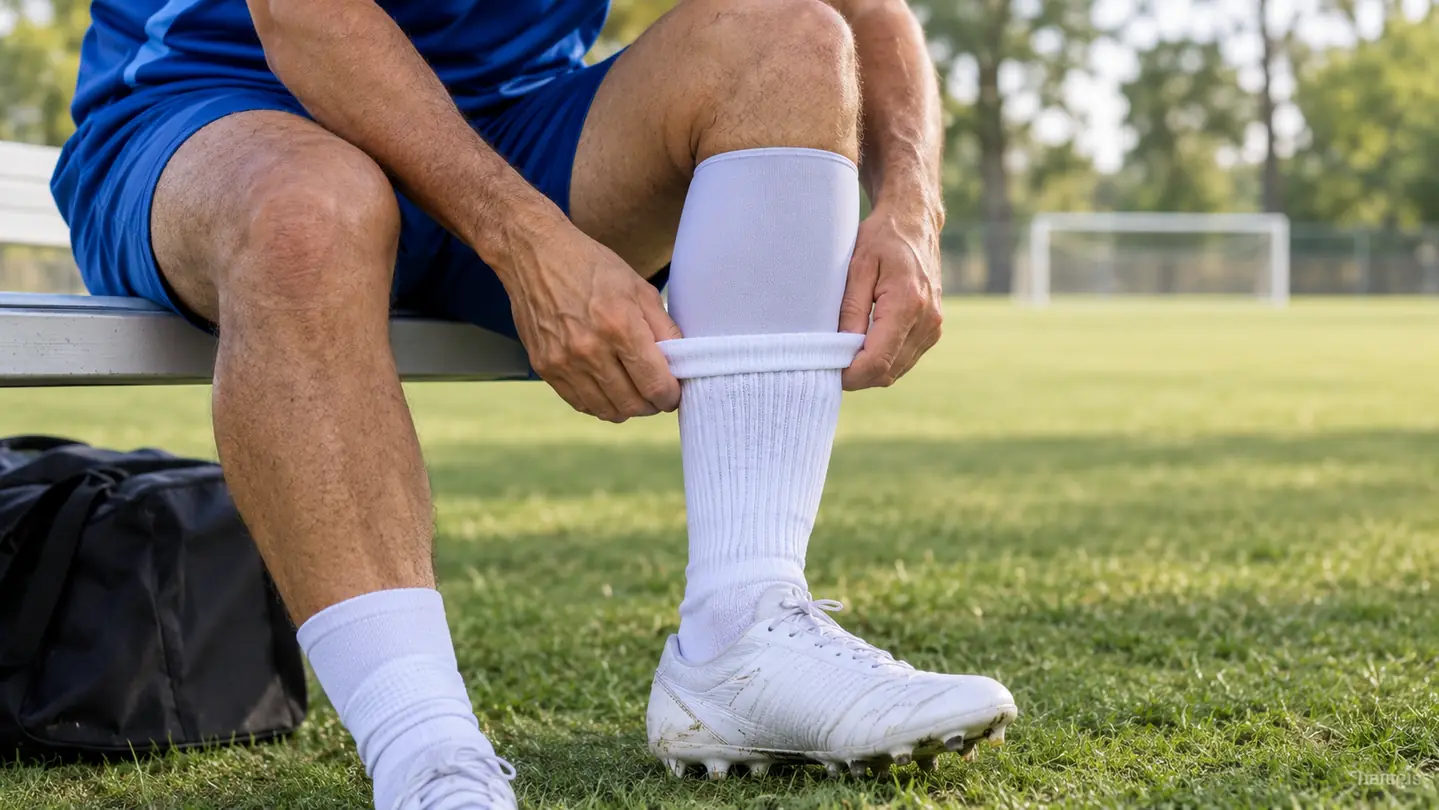
Step 2: Move easy for five minutes before you stretch anything
Old-school warm-ups started with a circle and a lot of toe touches. That never worked for me. A cold calf does not lengthen when you yank on it, it just gets annoyed. So I jog first. Two laps at a pace where I could hold a conversation, no more. Five minutes of easy movement and the rest of the routine behaves completely differently.
I learned that the hard way one February night when I got to the field late, lights already on, and went from the driver's seat to a sprint in about four minutes. Nothing tore. But I spent the whole first half managing it instead of playing, and I remember standing at the water break trying to decide whether to say something to anybody or just gut it out. Now I jog the two laps even when I am late, even when the whistle has already gone and the ball is already out there.
Lap three I add some shape to it. Side steps, a few backpedals, high knees that are honestly more about my hips than my calves. I keep the whole thing under seven minutes because I am not trying to win a fitness test at 7:45 on a Wednesday. The point is blood moving, not getting tired before kickoff.
Only after that do I do anything that looks like a stretch. A slow calf stretch against a goalpost, about thirty seconds a side, knee soft, breathing out into it. If it feels sharp I stop and walk for a minute. There is a real difference between tight and hurt, and the older I get the more honest I have had to be with myself about which one I am feeling.
Step 3: Roll the calf out, then re-check the sleeve
I keep a TriggerPoint GRID roller in the corner of my garage next to a yoga mat, and on game days it goes in the truck with my bag. Thirteen inches, multi-density surface, bought about three years ago. The roller it replaced was a smooth basic foam roller that went soft in the middle after a couple of years of steady use and stopped doing much of anything. This one has held its shape, and thirteen inches is the length I want, because I can get both hands on it and work one calf at a time without the thing skidding across the concrete. Before a game I roll each calf for thirty to forty seconds, slow, and I stop on the spots that complain rather than rolling straight over them. It is not a deep tissue session. It is a check-in, and it tells me whether tonight is a normal tight night or a leave-the-long-balls-alone night.
After rolling I check the Rymora sleeve again, because rolling can push it down a touch or twist it, and a twisted sleeve is worse than no sleeve at all. Top edge straight, fabric flat, one more set of calf raises. Then I leave it alone. Fiddling with it every five minutes just moves the bunching around.
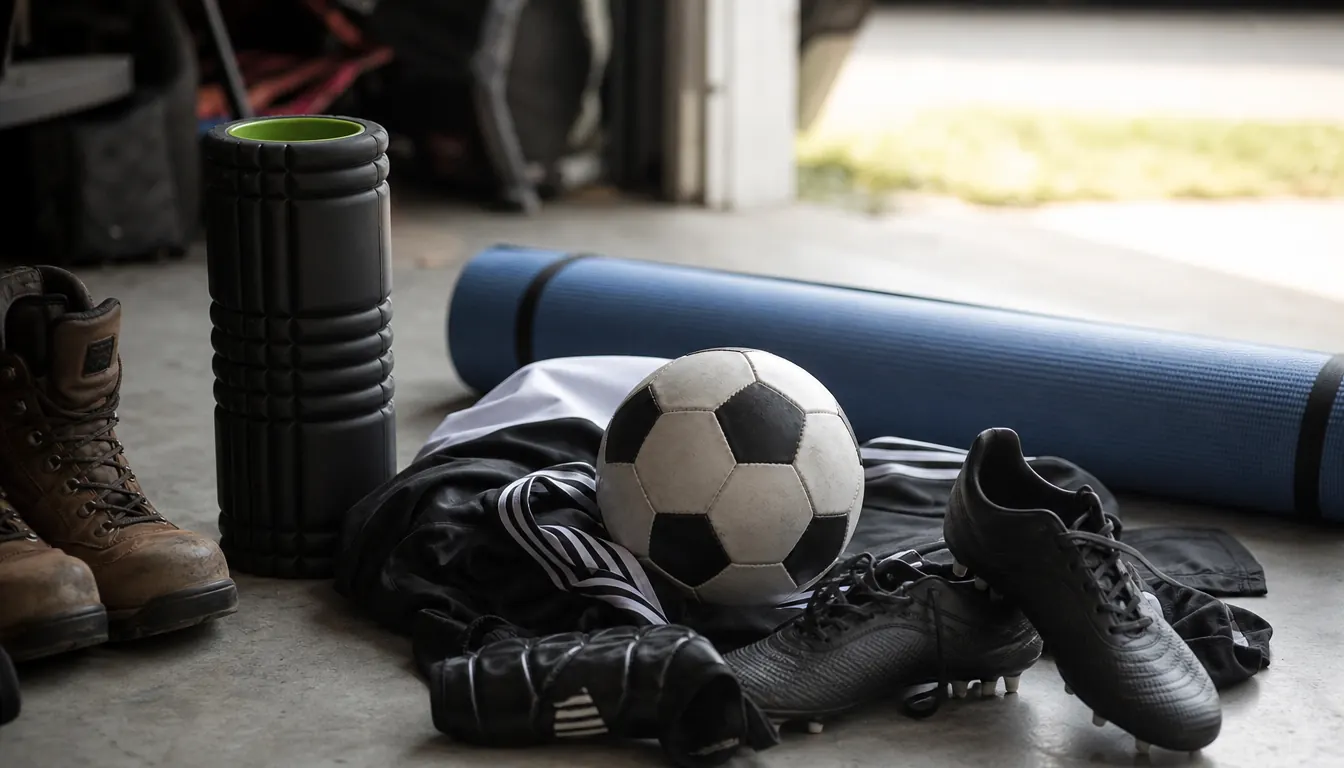
Step 4: Build up to game speed in stages, not in one sprint
This is the step that actually changed things for me. Most adult players go from a jog straight into a full sprint inside the first five minutes, because the ball goes over the top and the body does whatever the brain says. Your calf has not been asked to do that yet. So I ask it to do that before the whistle, where I control the dose.
The progression is simple. Three build-up runs at roughly 60, 75 and 90 percent, each maybe twenty yards. Then two short sprints from a standing start, the kind you do when you are closing down a fullback. Then two or three long balls, because that is the movement that pulls my calf hardest, the locked ankle and the follow-through. Six minutes, no more, and I am ready for the actual thing.
With the sleeves on, this part feels different than it did without them. I am not going to put a number on it or claim a percentage. I will say the leg feels held together through the build-up runs, and by kickoff I am thinking about their midfield and not about my calf. If you copy one step from this article, copy this one. The sleeve is the support. The progression is the work.
Step 5: Handle the hour after the game, and know when to call somebody
Full time is where most weekend players undo the whole thing. Straight to the car, straight to the couch, and then Thursday morning the calf is a brick. I take my boots off, put normal shoes on, and leave the sleeves on for the drive home on turf nights. Then off they come, shower, water, something with real food in it.
At home I roll again, gently, five minutes total across both legs, calves and hamstrings. Not deep, not heroic, just enough to feel like I did something. Monday morning I am back on the garage floor at 6:40, before my first service call, with a coffee going cold on the workbench. Ten minutes that time: calves, hamstrings, quads, and a slow pass down each side for the IT band, which I would not have known to do if my physical therapist had not shown me years ago. It is boring and I do not enjoy it. That Monday session is the one I notice most, because skip it and Wednesday night feels twice as long, and by the second half I am back at the halfway line watching the game go past me.
And now the part that matters more than any gear. If the tightness turns into sharp pain, if it lives in one spot the size of a coin, if it hurts to push off or it swells, stop reading articles and go see a doctor or a physical therapist. I rolled my right ankle badly about six years ago and I did the rehab properly with a PT, and the lesson from that was simple. The Rymora sleeve helps me feel supported and stay consistent. It does not diagnose anything and it does not heal anything. Anyone who tells you otherwise is selling, not helping.
What Else Helps
A few other things made more difference than I expected, and none of them are exciting.
The hamstrings. My calves were doing work the hamstrings should have been doing, because the hamstrings were tight and weak. Twenty minutes a week of slow hamstring work on the garage floor, plus rolling them in the same Monday session, changed how my calves felt on turf more than any single piece of gear did.
The gap between games. Sunday on grass and Wednesday on turf is two hard loadings in three days for a 48-year-old body. I used to add a Thursday pickup game on top of it and wonder why my calf was angry by the weekend. Now I play two, and I treat Monday as a recovery day rather than a day off I feel guilty about.
The feet. My feet were sliding inside my cleats on turf, and a sliding foot makes the calf work overtime to stabilize everything above it. Grip socks fixed that for me, worn under my regular team socks, and the difference in how my lower leg feels after ninety minutes was immediate. Small thing, real effect.
What I would skip. Long static stretching on a cold calf before you have moved at all, which I did for years and got nothing from. Buying on brand name alone. I tried a pair of Blitzu sleeves first because a sporting goods store had them on the shelf, and I returned them within a week because the fit was wrong for my leg. And skip the idea that a sleeve lets you play through something that is actually hurt. It does not, and I have watched teammates find that out the hard way.
The sleeve does not warm my calf up. It keeps the calf I warmed up from feeling like it came undone at the first sprint.
The part of the routine I do not skip anymore
Eighteen months in, two pairs, one in the wash and one in the truck. They go on in the parking lot and come off after the drive home.
Amazon Check Today's Price on Amazon →