
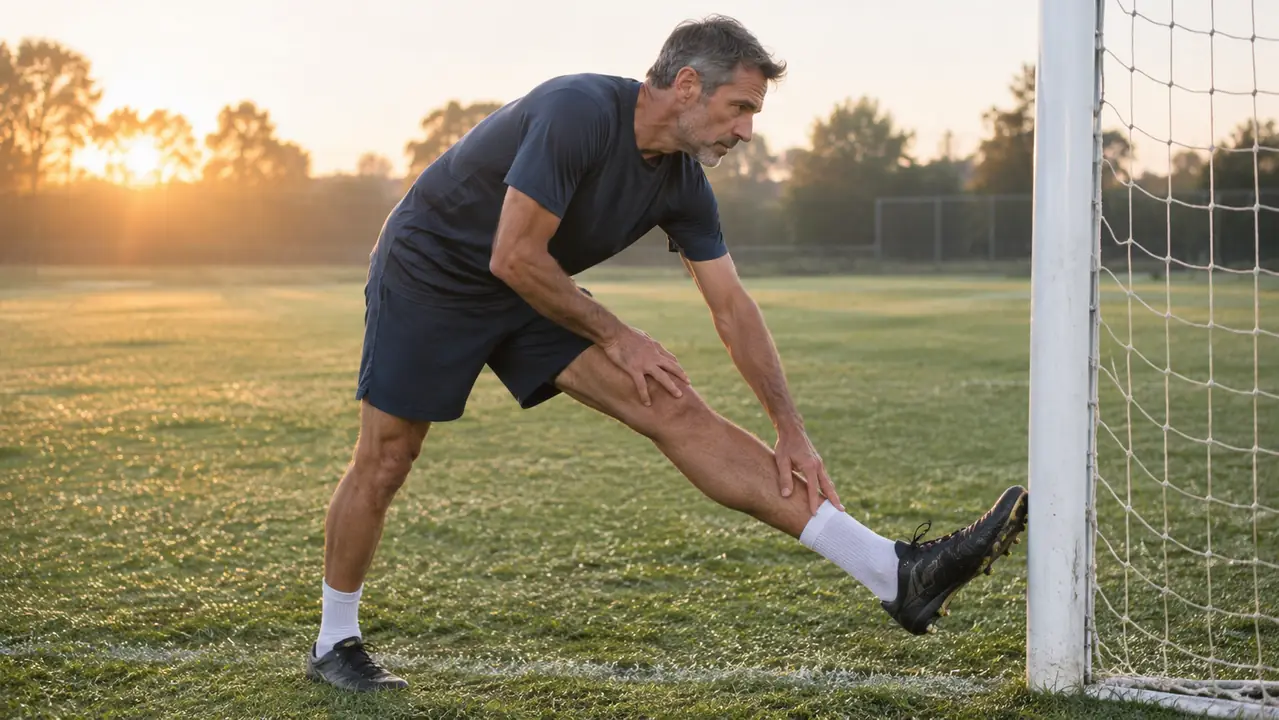
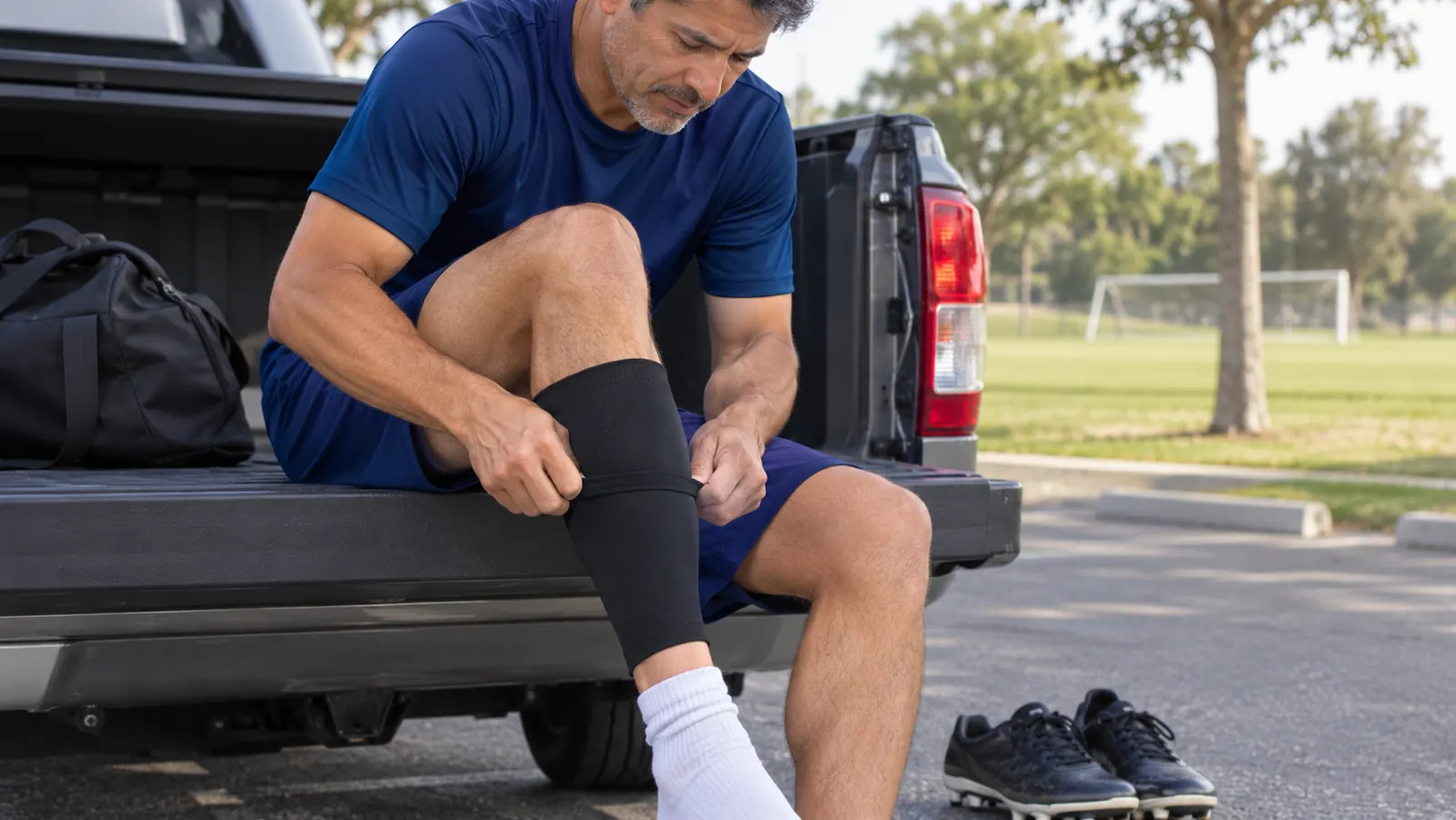
The first time I pulled on a pair of Rymora calf sleeves it was 6:40 on a Sunday morning and I was sitting on the tailgate of my truck in a city park parking lot, trying to get them up my legs without bunching them at the ankle. I am 48. I fix air conditioners for a living, and I play center midfield in an over-40 league on Sunday mornings on grass and a 7-a-side pickup game on Wednesday nights on turf. My calves have been the loudest part of my body for about three years now, and the drive home from a Wednesday game used to be the worst twenty minutes of my week.
I bought the Rymora sleeves about 18 months ago for that specific problem, not because anyone told me compression would fix me. I own two pairs now. I wear them for warm-up and for the game, and on the bad weeks I wear them in the truck on the way home. This is what I have learned after roughly 70 Sundays, 60-odd Wednesdays, a summer of heat that made me question all of it, and one winter where I wore them under sweatpants in the garage while I rolled my legs out on a Monday morning.
The Quick Verdict
Eighteen months of real use and they have not gone slack or lost their shape. They help me feel supported during and after a game, they wash clean, and they cost less than a decent pair of socks. They will not fix a calf that needs a professional, and they are not built for people who want a hard medical-grade squeeze.
Amazon Check Today's Price →If your calves are the first thing to quit on a Wednesday night, start here
These are the sleeves I have worn for 18 months of Sunday grass and Wednesday turf. Two pairs, zero pairs retired.
Amazon Check Today's Price on Amazon →How I've Used It
My routine has not changed much in 18 months. I get to the park about 35 minutes early, which sounds disciplined and is really just me being afraid of being late. I put the sleeves on before I put my socks and shin guards on, because doing it the other way around is a waste of time. Then I do a slow lap, some walking lunges, a few short sprints, and a set of calf raises off the edge of a curb. The sleeves go on for that whole block. On Wednesdays on the turf I put them on in the truck before I even get out, because the turf is the surface that punishes me.
Sunday is 90 minutes on grass at a city park, and my role means a lot of jogging and a lot of stopping. Wednesday is 60 minutes of 7-a-side on artificial turf, which is shorter, sharper and much harder on my lower legs. I am not a sprinter. I am the guy who holds position, wins a header he should not win, and then takes four seconds too long to turn around. But I cover ground, and by the 50th minute on turf my calves used to feel like they were being pulled from both ends.
I do not wear them for everything. I do not sleep in them, I do not wear them to work, and I do not wear them around the house on the theory that more is better. They go on before a session and come off in the shower afterward, or in the truck if I am going straight to a family thing. That is the whole protocol. Eighteen months of that, twice a week, and they are still the first thing I reach for in the bag.
What the Fabric Actually Is
The listing says 54% nylon, 39% polyester and 7% elastane, and that mix is the reason these have lasted. The nylon carries most of the durability, the polyester keeps them from feeling slick against the skin, and the elastane is the small percentage doing the big job of pulling them back into shape. Seven percent is not a lot, so the recovery has to come from how the knit is built rather than from a rubber-band effect, and in my experience that is exactly what happened. They stretch when I pull them on and they come back. They have not gone baggy at the top.
They are footless, they pull on, and they sit from just below the knee down to the ankle bone with nothing under the arch. That last part matters to me because I wear a lace-up ankle brace on my right side, and a sleeve with a stirrup would fight it. The fit is described as slim, and mine are snug enough to stay put through a full game without me tugging at them once. They are medium weight, so they are not see-through thin and they are not so thick that I notice them under a sock.
Sundays on Grass, Wednesdays on Turf
The honest version is that the sleeves help me most on turf and least on grass. On Wednesday nights the turf grabs at a cleat and the whole lower leg gets a jolt it did not ask for, and the sleeve makes that feel less sharp to me. It is not a cushion. It is closer to the feeling of someone having a hand on your back. But it is a real difference, and I noticed it in the first month, and I noticed its absence the one Wednesday I forgot them and had to borrow a spare pair of socks from a teammate.
On Sunday grass they are more of a warm-up tool for me. Grass is forgiving, and my calves mostly complain later, in the truck and on Monday morning. That is where the sleeves have a second job. I keep them on for the drive home and take them off in the shower, and by the time I am on the couch with an ice pack on my knee for unrelated reasons, my calves have quieted down. I want to be careful here: I am not telling you they speed up recovery in some measurable way. I am telling you that my legs feel less angry on the drive home, and that is worth something to a 48-year-old with a job on Monday.
The heat is the one complaint I have. San Antonio in July is not a gentle place, and a medium weight sleeve on a 95 degree morning adds warmth I do not want. I still wore them, because the alternative was worse, but I noticed. If you run hot or you play in a real summer, that is a genuine tradeoff and you should know it going in. I skipped them for a couple of the worst August pickup games and did not feel punished for it.
What I Liked
- Still snug and shapely after 18 months and roughly 130 sessions across two pairs
- Footless cut sits cleanly under a soccer sock and does not fight a lace-up ankle brace
- Stays where I put it for a full 90 minutes without tugging
- Machine washable, and mine have been through the wash more times than I can count without pilling or going thin
- Noticeable difference on artificial turf, where the jolts are sharpest
Where It Falls Short
- Medium weight fabric is warm, and I skip them in the worst of the summer
- No arch strap, so if you want something anchored under the foot this is not it
- Getting them on over a sweaty calf after a game is a small wrestling match
- They will not do anything for a calf that actually needs a professional
I forgot them one Wednesday, borrowed a pair of socks off a teammate, and spent the drive home understanding exactly what I had been paying for.
What Wore Out and What Didn't
This is the part I actually care about, because I have thrown out more gear than I have worn out. Eighteen months in, neither pair has a hole, a run, or a seam that has started to let go. The top band on my older pair has softened a little compared to the newer one, but it still holds position during a game, which is the only test that matters. The fabric between the calf and the ankle has not gone shiny or thin the way cheap stretch fabric does.
The one thing that changed is the fit feel, and only slightly. The older pair goes on a touch easier than it did in month two, which I read as normal break-in rather than failure. They have not stretched out to the point where they slide down. I have washed both pairs on a normal machine cycle and let them air dry, which is what the care instructions call for, and I have never put them in the dryer. I think that is most of the reason they are still alive.
For context, my Franklin shin guards are about two years old and still fine, my ankle brace is on its second unit after the first one gave out around the three year mark, and my foam roller is three years old and going nowhere. The Rymora sleeves are tracking right along with that group. Nothing about them feels like it is on a clock.
How They Fit Around the Rest of My Gear
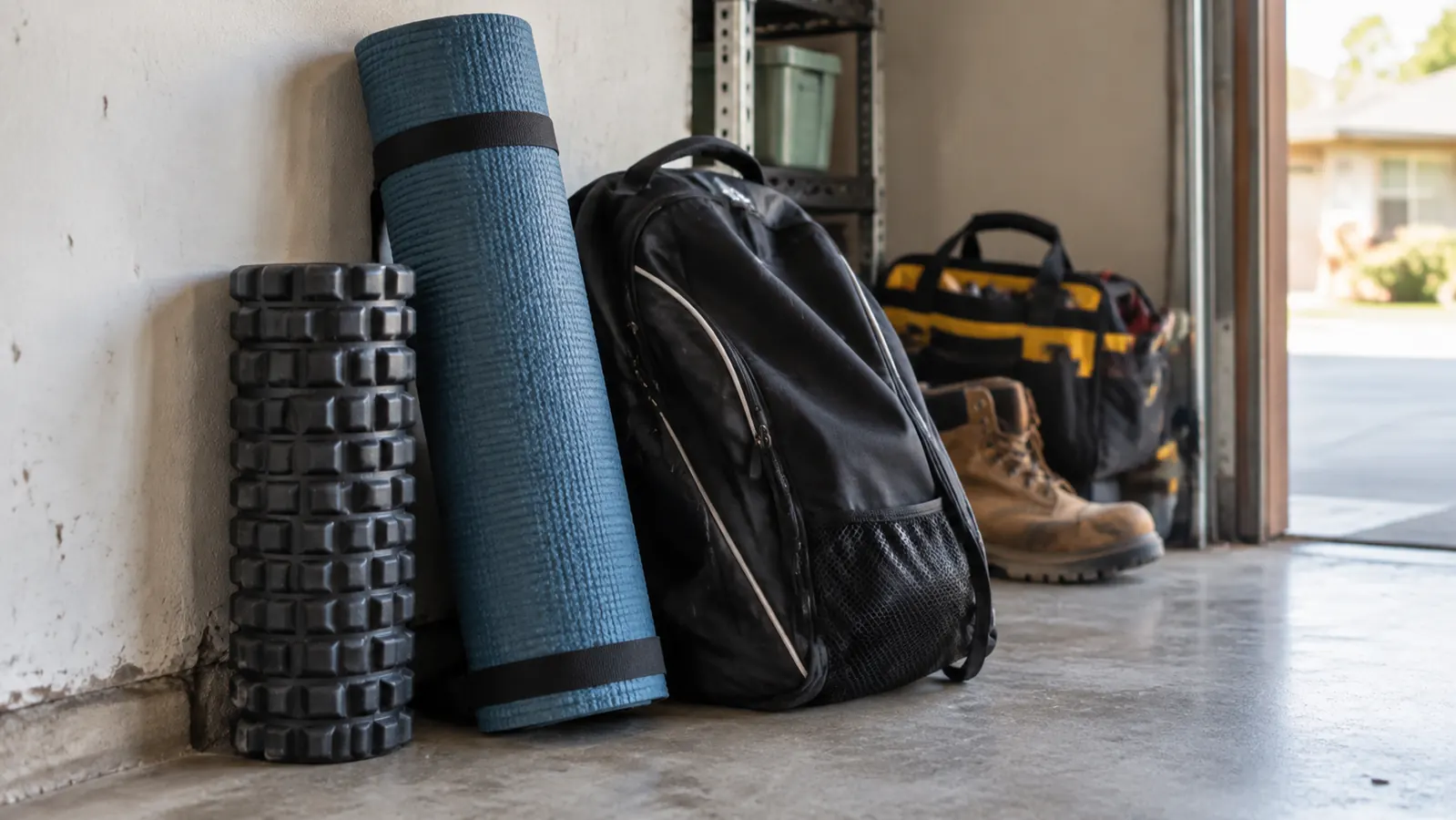
My right ankle got rolled badly about six years ago, and a physical therapist set me up with a lace-up brace that I have worn for every game since. That brace and these sleeves have to share the same lower leg, and they do it without a fight because the sleeve stops above the ankle and there is no strap running under my arch. I put the sleeve on first, then the brace, then the sock, then the shin guard, then the cleat. It takes about 90 seconds and I have done it in a parking lot in the dark.
One thing worth saying plainly: the sleeves do not protect my shins and the shin guards do not support my calves. Those are different jobs and I do not pretend otherwise. The sleeves are for the calf, the brace is for the ankle, the guards are for the kicks, and the roller in the garage is for afterward. Gear helps me feel supported and stay consistent. It does not stop anything from happening, and if something actually hurts, I am going to a doctor or a physical therapist, not to my gear bag.
Who This Is For
This is for the recreational player in their 30s, 40s or beyond whose lower legs are the first thing to complain. The one who plays once or twice a week, works a job that is not sitting at a desk, and wants to still be doing this at 60. If you play on artificial turf, I think you will notice the difference faster than I did on grass. If you are coming back from a layoff and your calves are letting you know about it after every session, this is a reasonable, low-drama thing to try, and it costs less than a lot of the gear already in your bag.
It is also for the person who wants something they can put on themselves in a parking lot, without help, without straps to adjust and without a size decision that requires a fitting. I went by the size chart on the listing, and mine came out right on the first try, which is more than I can say for most things I buy online. Two pairs is the right number for me because one is always in the wash.
Who Should Skip It
Skip these if what you want is a hard medical-grade squeeze. This is a comfortable, slim, medium weight sleeve, and it is not the same product as something a clinic would fit you with. Skip them if you run hot and play in a real summer, because you will leave them in the bag in August like I did. Skip them if you want a stirrup under the arch or a strap to crank down, because there is neither. And skip them if you are hoping a piece of fabric is going to solve a calf problem that has been building for a year. That is a conversation for a professional, and no sleeve is going to have it with you.
One last practical note. Getting them back off after 90 minutes in the heat is a small battle. It gets easier if you peel from the top and roll rather than pull from the ankle, and it gets much easier once you have done it a dozen times. It is not a reason to avoid them. It is just the sort of thing I wish someone had told me before my first Sunday, when I sat in the truck for five minutes working one of them over my heel.
Eighteen months in, both pairs are still in the bag. That is the whole review.
If your calves are what limits you on turf, this is the cheapest fix I have found that I did not end up throwing away.
Amazon Check Today's Price on Amazon →