
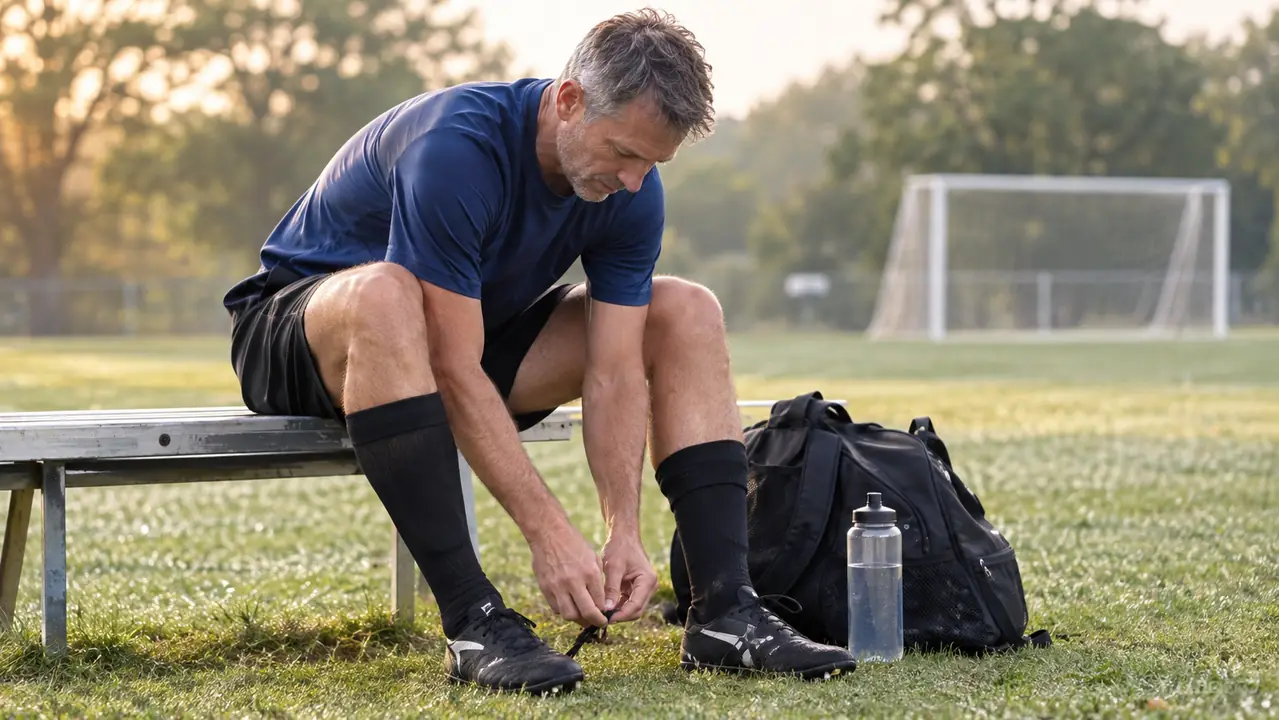
The first time I noticed it I blamed my cleats. It was a Wednesday night on the artificial turf, and every time I planted to turn, my foot shifted inside the boot a half step before the boot actually moved. Half a step of slop on every cut. By the end of the hour my toes were jammed into the front of the cleat and I had a hot spot on my heel the size of a coin. I spent two weeks tightening my laces, then two weeks loosening them, which is the kind of problem solving I do when I do not want to spend anything. Neither one worked, because laces squeeze the whole foot evenly and the sliding was happening in one spot. About five months ago I bought a four-pack of Yufree soccer grip socks, put them on under my regular team socks, and the sliding stopped the first night.
Here is the short version before the steps. If your foot moves inside the cleat, a tighter lace is not the fix, because the lace is not what is failing. What is failing is the layer between your skin and the inside of the boot, which is usually a thin cotton sock or a worn team sock that has gone slick with sweat. That layer has no grip. The fix is to put something with grip directly against your foot and then re-lace around the new thickness. I am not going to tell you it makes you faster, and I am not going to tell you it prevents anything. What I will tell you is that I stopped jamming my toes into the front of my cleats, I stopped getting the heel hot spot, and somewhere in the second half I stopped thinking about my feet at all. That last part is the whole point.
The layer that stopped my foot from sliding, five months and two nights a week in
Four pairs, mid-calf, grip pads on the sole, machine wash. I wear them under my team socks for both the Sunday grass game and the Wednesday turf game.
Amazon Check Today's Price on Amazon →Step 1: Find Out Which Way Your Foot Is Actually Moving
There are three ways a foot moves inside a cleat and they behave differently. The heel lifts up and down, which is heel slip. The forefoot slides forward on a plant, which is why your toes end up jammed against the front of the boot. Or the whole foot rotates inside the shoe when you cut, which is the one that got me on the turf. To figure out which one you have, wear your normal setup, jog ten steps, plant and turn hard in both directions, then pull the cleat off and look at the sock you just took off. A shiny stretched patch at the back of the heel means heel slip. A thin spot or a hot spot under the big toe means forefoot slide. Grip pad impressions smeared off to one side means the whole foot is rotating.
While the cleat is off, pull the insole out and look at it. The factory insole in a pair of cleats that has seen a full season of sweat gets polished and slick on top, and no sock is going to fix that on its own. If the insole slides around loose in the shoe, or the top surface shines, replace it or at least rough it up before you spend anything on socks. Also check what you are currently wearing on your feet. A thin dress-weight cotton sock, or a team sock that has been washed forty times and gone soft, is basically a lubricated layer. You have been asking the shoe to hold a foot that is floating on a wet cloth.
Most of the guys I play with buy a new pair of cleats when they have this problem. I have done it. The cleats were not the problem. Nothing was wrong with the boot. The layer inside it had stopped doing its job, and I had been blaming the boot for three seasons.
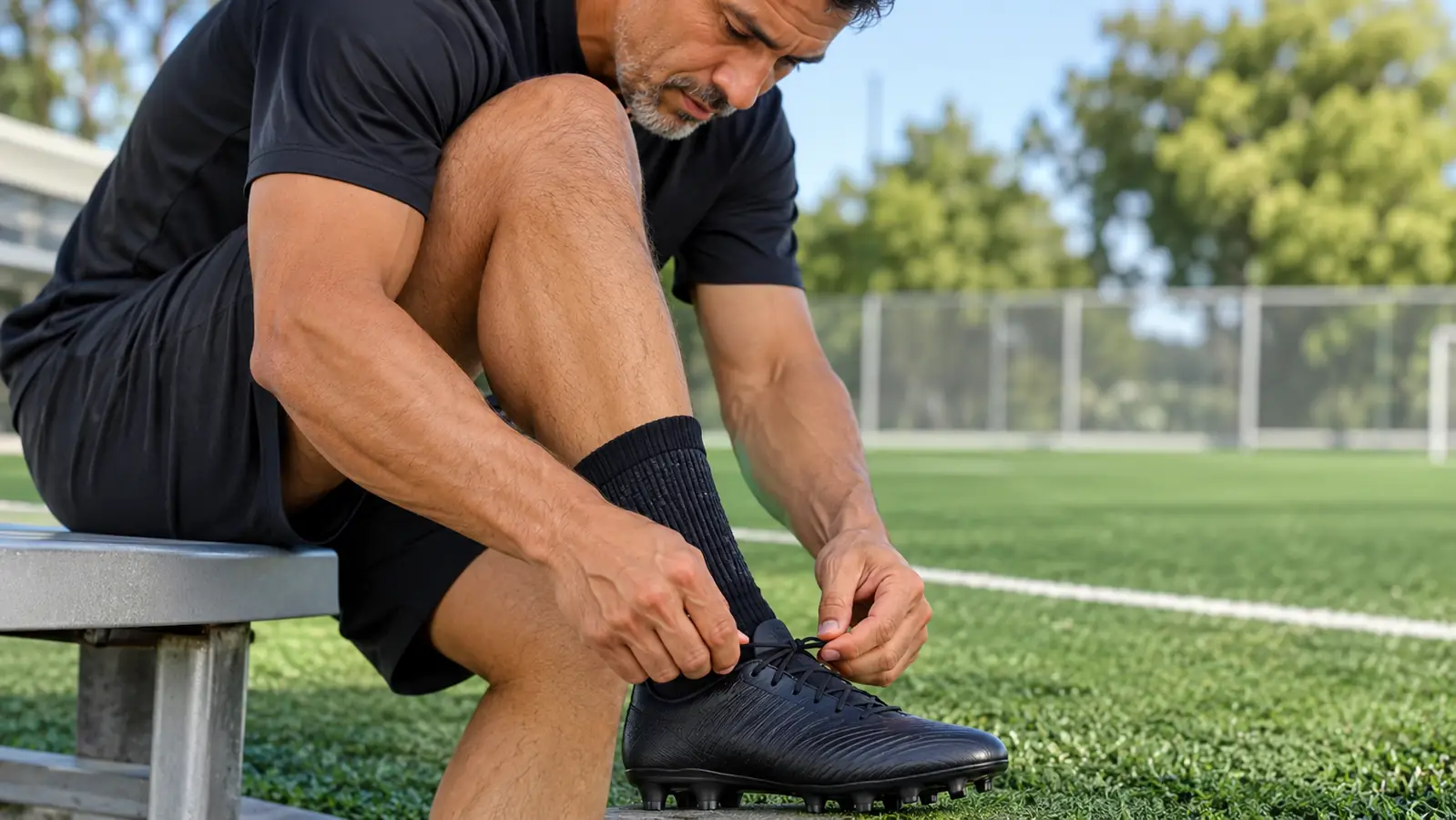
Step 2: Put a Grip Layer Directly Against Your Foot
The Yufree grip socks go on first, against bare skin, and then your team sock goes on over the top of them. That is the entire change. Five months in, this is my setup for the Sunday over-40 grass game and the Wednesday night pickup game on turf, and I noticed the difference inside the first twenty minutes of the first night. Not that it felt nicer. The half step of movement was simply gone, and I could plant off my right foot without bracing for the slip first.
The listing says 56 percent nylon, 34 percent cotton and 10 percent elastane, medium stretch, mid-calf, pull-on, machine wash, sold as four pairs. That matches what they feel like: a thin, snug athletic sock, not a thick padded one. Which matters, because if you put a thick sock in a cleat that was fitted for a thin one, you have created a whole new problem. These are light enough that they did not change how my cleats fit, they just changed what was happening inside them.
The team sock over the top is the part people ask me about. A full team sock on top of a grip sock is two layers in a shoe that was sized for one, and for a couple of weeks I could feel the extra volume across the top of my foot. What I ended up doing was sacrificing an old pair of team socks, cutting the feet off them so what is left is a tube I pull on over the grip sock. My calf gets the team sock look, the inside of my cleat gets one layer plus grip. I keep the intact pair for games where the ref cares how the socks look.
Step 3: Re-Lace the Cleat Around the New Thickness
Adding a layer changes the volume inside the boot, so the lacing you had dialed in for one sock is now wrong. Loosen the bottom three eyelets all the way, push your heel to the back of the shoe, then work up from the bottom. Snug through the midfoot, not tight. Tight through the ankle. I put a heel lock in the top two eyelets so the lace pulls the heel down and back instead of letting it float. It takes about ninety seconds once you have done it twice, and it is the difference between the grip sock working and the grip sock making your toes go numb.
Test the fit before you leave the house. Tap the end of the cleat and see how much room is past your longest toe. If your toe is touching the front wall now and it was not before, you have stacked too much sock in there and you are going to lose a toenail on a long ball. The other check is the heel. Take three steps, plant hard, and feel whether the heel stays down in the shoe. If it lifts with the lace tight, the lacing is wrong, not the sock.
One more thing if you wear any kind of ankle support. I wear a lace-up brace on my right ankle, the same one I have worn for every game since I rolled it badly about six years ago and did the rehab with a physical therapist. A brace takes up real room inside a cleat, and adding a sock layer on top of that room is a lot to ask of a shoe. Both layers go on before the cleat, and the lacing gets redone every time. If it gets tight enough that your foot goes cold, the shoe is too small for that combination and you should talk to somebody who fits cleats for a living rather than forcing it.
The sliding stopped the first night. Not felt better, stopped. Twenty minutes in I was planting off my right foot without thinking about it first, and that is the only test that counts.
Step 4: Test It in a Real Session, Not in Your Living Room
Do not break these in during a match you care about. Wear them for a warm-up and about twenty minutes of drills, or a pickup game where the result does not matter to anybody but you. The reason is simple: foot slide problems show up when you are tired and cutting badly, and that is not something you can recreate jogging up and down your hallway. You need to be a little out of breath and a little late to a ball.
After that first twenty minutes, pull the cleat off and look. Look at your foot where the hot spot used to be. Look at the sole of the grip sock and see whether the pads are still sitting where they started. Look at the heel of your foot for any red mark. What you want is nothing. No hot spot, no jamming in the toe box, no red stripe across the top of your foot where the lace was biting. If you got through twenty minutes of real cutting with no marks, you have probably fixed it.
If it did not work, do not go buy six more pairs of socks. Go back to Step 1 and be honest about what you saw. If the slide is still happening at the heel, the problem is lace tension and heel lock, not the sole. If your toes are still jamming, the cleat is likely a half size long and your foot is sliding forward to find the end of it. And if anything actually hurts, a sharp pain, a joint that swells after a session, a nerve that tingles, that is not a sock problem and I am not the guy to ask. I have a physical therapist for that and so should you.
Step 5: Wash Them Properly So the Grip Survives
The Yufree socks go in the machine on a normal wash and they get air dried, hanging off the side of the laundry basket in the garage. I do not put them in the dryer and I would not. Heat and a rubber grip surface are not friends, and a glazed, hardened pad is a pad that does nothing. Five months in, mine still look like socks rather than something I scraped out of a turf field.
The bigger issue is not washing, it is the bag. My soccer bag rides in the back of my work truck all week, which means whatever went in there Sunday morning is still in there Wednesday afternoon, damp, at whatever temperature a truck cab reaches in San Antonio. That is what kills gear. The socks come out of the bag and onto the drying rack the same night, every time. It costs me thirty seconds and it is why the four pairs I bought five months ago are still in rotation.
Rotating pairs is the other half of it. My son Gabe took one of the four Yufree pairs for his high school season, so I am working with three, and I still get through a week without wearing a damp pair. Replace them when the pads feel smooth and hard rather than tacky, because at that point they are just socks. Which is still useful. It is just not the thing you bought them for.
What Else Helps
Fix the rest of the stack, because a cleat is a stack of layers and one bad layer ruins the whole thing. If you wear an ankle brace, that brace goes against the skin or against a thin sock, and the whole order has to be worked out once and then repeated exactly. I use a lace-up brace on my right ankle, and I have found the grip sock has to go under it, not over it, or the brace slides on the sock instead of locking the ankle. If you wear calf sleeves for tight calves on turf, get footless ones. A sleeve with a foot in it is another layer inside the shoe and it will fight everything you just did.
Look honestly at the other gear while you are at it. My shin guards are slip-in shields with foam backing, and the straps have to sit right or they bunch under the sock and create a pressure point that feels exactly like a fit problem. My cleats are the same pair I have worn for two seasons, laced the way I described above, and I check the insoles every few weeks. None of that is exciting and all of it is cheaper than replacing cleats. The Yufree socks were the last piece I added and the only one that changed anything.
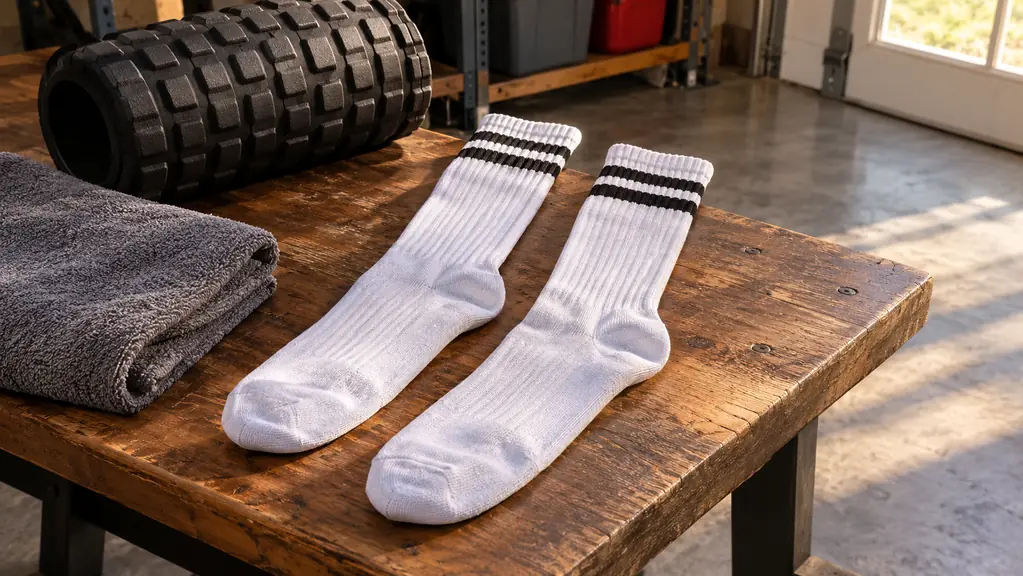
And keep the legs loose. I roll my calves, hamstrings, quads and IT band on a foam roller in the garage for about ten minutes after games and again on Monday morning, because tight calves change how my foot lands, and a foot that lands badly is a foot that slides. That is not a cure and it is not treatment. It just means I show up Thursday able to move normally. Anything that actually hurts, sharp or persistent or swollen, goes to a doctor or a physical therapist. Gear helps me feel supported and stay consistent. It does not fix a body, and anyone who tells you otherwise is selling something.
Four pairs, five months, and my toes stopped hitting the front of the cleat
Mid-calf, pull-on, machine wash, grip pads on the sole. Wear them under your team socks and re-lace around the new thickness. That is the whole method.
Amazon Check Today's Price on Amazon →