
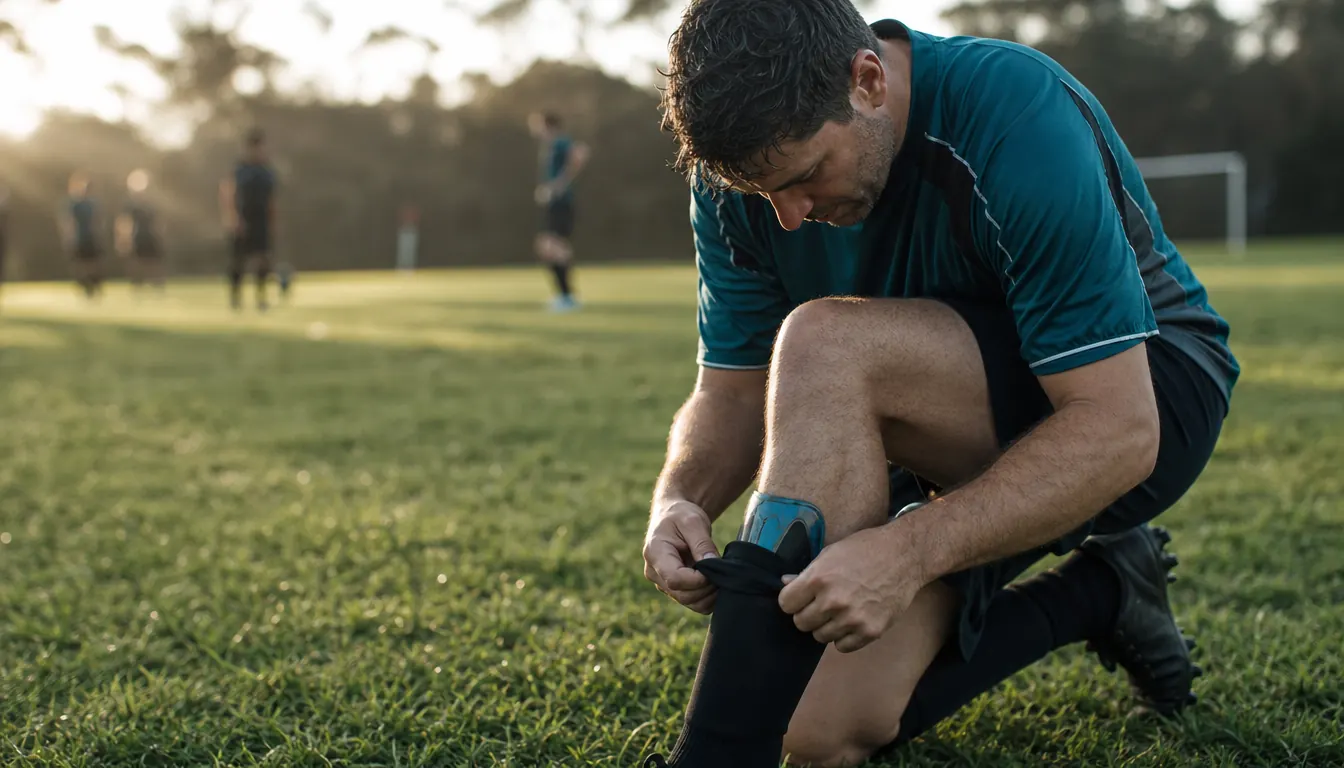
I have worn the Franklin Sports Superlight shin guards for about two years, every Sunday in an over-40 league and most Wednesday nights on turf. I am 48, I play center midfield, and I still bring a spare pair in my bag for the teammate who forgot his. The guard itself is simple: a foam-backed shield, two self-stick straps, and a pull-on closure. The hard part is not buying it. The hard part is getting the size right.
Most players I know size shin guards by holding them against the leg in the parking lot. That works until the guard slides down during a run or the top edge digs into the knee. I have had both happen. The fix is to measure your shin, then match that number to the guard's listed length and to the way the straps sit on your calf. The Franklin Sports Medium is a useful example because the listing gives real numbers: 11 inches long, 5 inches wide, and a stated range of up to 5 feet 3 inches for ages 6 to 12. I wear a Large in the same model, but the Medium is the pair I can measure against a tape.
The fit starts with the length, not the label
The Franklin Sports Superlight comes in youth and adult sizes. Check the listed length and width against your own shin measurement before you order.
Amazon See the Franklin Sports Superlight on Amazon →Step 1: Measure shin length with a tape, not with your height
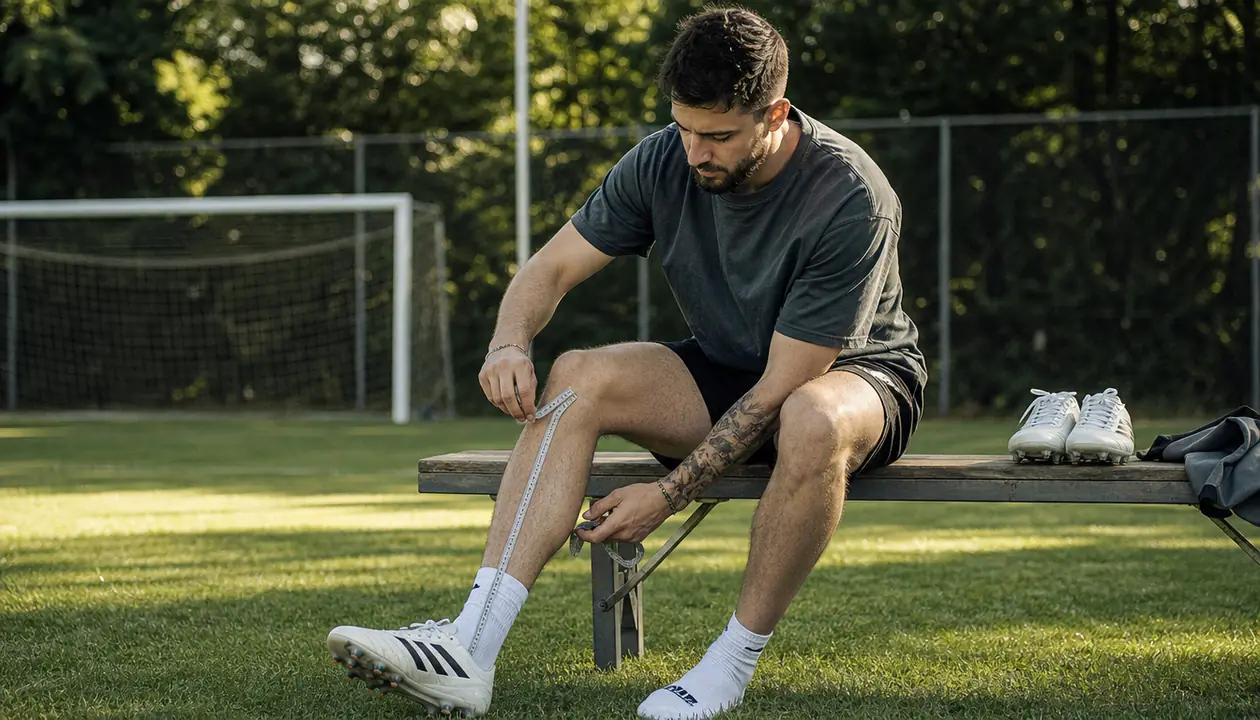
Sit on a bench with your cleat on. Find the bony point on the outside of your ankle, then the bottom edge of your kneecap. Measure the straight line between those two points. Do not wrap the tape around the calf. Do not measure from the floor. I check both legs because my right ankle has an old sprain and the leg sits a little differently when I stand. I write both numbers down and use the longer one when I am between sizes.
The Franklin Sports Medium is listed at 11 inches long. That is the shield length, not your leg length. A guard that is 11 inches long will cover a shorter shin from just above the ankle to just below the knee. If your measurement is much longer than that, the Medium will leave a gap at the top or bottom. The listing also gives 5 inches of width. Width matters when the guard wraps around the front of the shin. Too narrow and the edges press into the sides. Too wide and the guard rotates when you plant your foot.
The height range on the listing is a shortcut, not a measuring tape. Franklin Sports gives the Medium as up to 5 feet 3 inches and ages 6 to 12. An adult who is 5 feet 2 inches might fit the length and still want a different strap fit. A 12-year-old who is tall for his age might be past it. Use the height and age as a first filter, then use the tape. That is the order I use in my own bag before I hand a pair to a teammate.

Step 2: Check where the top and bottom edges land
Put the guard on over a thin sock or directly on the leg, then pull your team sock over it. Stand up and bend the knee. The bottom edge should sit above the ankle bone, not on it. The top edge should stop below the kneecap. If the top edge touches the kneecap when you bend, the guard is too long for that spot or it is sitting too high. If the bottom edge digs into the top of your cleat, it is too low. I check this in a mirror before every Sunday game because the strap can pull the guard up an inch if I rush.
With the Franklin Sports Medium, the 11 inch length is the number to watch. On a shorter leg it can run from the ankle to just under the knee with room to spare. On a longer adult leg it may sit like a short guard. That is not a defect. It is the size doing its job. I wear a Large, and I still check the top edge because my calf pushes the guard up when I tighten the upper strap too much. The guard should cover the front of the shin without crowding the knee.
The symmetrical design means there is no left or right guard. That is handy when I am digging in my bag in the dark, but it also means you have to set the height yourself every time. I put the guard on, press it against the shin, and mark the strap spots with my thumb before I tighten anything. If the guard has a distinct top and bottom in your hands, you can ignore that and let the straps decide the height. The shield is meant to sit flat against the shin.
Step 3: Set the two straps so the guard stays put
The Franklin Sports Superlight has two adjustable self-stick straps. The lower strap should cross just above the ankle, below the widest part of the calf. The upper strap should sit below the back of the knee, not across the crease. If the upper strap sits in the crease, it will roll down when you run. I learned that in my first month with these guards. Now I set the upper strap first, then the lower one, because the top strap controls most of the sliding.
Tighten the straps until the guard does not shift when you press it side to side with two fingers. You should still be able to slide a finger under each strap. If the strap leaves a deep mark after ten minutes, it is too tight. If the guard slides down after a sprint, it is too loose. The pull-on closure and the straps work together, so check both before you blame the size. A loose strap can make a correctly sized guard feel wrong.
Do the test in the parking lot: jog twenty steps, stop, cut left, cut right, and strike a ball with the laces. If the guard climbs up or drops down, reset the straps. If it still moves, the length or width is wrong for your leg. I do this with every pair I buy, including the pair I keep for a teammate. It takes two minutes and saves an hour of adjusting during the game.
Step 4: Fit the guard to your sock and cleat setup
A shin guard does not live on your leg alone. It lives under a sock and above a cleat. A sock that is too tight can pull the guard up. A sock that is too loose lets the guard rotate. I wear my Franklin Sports guards under my team socks, and I check the sock cuff first. If the cuff is tight enough to leave a line on my calf, the guard will ride up. I switch to a sock with a softer cuff on those days.
The cleat matters too. A low-cut cleat leaves more of the ankle exposed, so the bottom edge of the guard has to sit higher. A higher-cut cleat gives the guard a shelf to sit above. I wear a standard low-cut cleat on Sunday and a turf shoe on Wednesday. The guard stays the same, but I check the bottom edge before each game because the shoe changes the way the sock sits. On turf, the sock tends to pull down a little more when I plant and turn.
If you use a lace-up ankle brace, put the brace on first, then the guard, then the sock. The brace adds bulk around the ankle, and the guard has to sit above it, not on top of the laces. I wear a brace on my right ankle, and I move the lower strap up about a finger width on that side. That is not a product feature. It is just what works for me. The guard still has to cover the shin, and the brace still has to do its own job.
Step 5: Recheck the fit after washing and after a month
Self-stick straps pick up lint and grass. When they do, they hold less firmly, and the guard starts to slip. I wipe the straps with a damp cloth and let them air dry. I do not throw the guards in the dryer. After a month, I check the strap hooks and the foam backing. If the foam is compressed flat or the shield has a crack, the guard is done. A cracked shield is what sent my old pair to the trash.
My old hard-shell pair cracked across the shield after years of use. That is why I replaced them with the Franklin Sports Superlight. The Superlight is lighter and the foam backing is softer against the shin, but it is not indestructible. The listing gives a 90 day limited warranty. I note that because it tells you what the maker expects, not because I have had to use it. I have not had a strap fail, but I have seen teammates keep using guards with stretched straps long after they stopped holding.
Check the fit at the start of every season. Your legs change. I lost weight two years ago and had to tighten both straps a notch. My son Gabe grew three inches in one year and needed a different guard length. The size on the label is a starting point. The tape and the mirror are the real test. If the guard no longer lands in the same spot on your shin, start over at Step 1 instead of guessing.
What Else Helps
Shin guards are one piece of a setup. I also wear a lace-up ankle brace on my right ankle, calf compression sleeves on turf nights, and grip socks under my team socks. Each one does a different job. The brace supports the ankle. The sleeves are for my calves. The grip socks stop my foot from sliding inside the cleat. None of them replace a correctly sized shin guard. If the guard is wrong, the rest of the setup cannot make up for it.
After games I use a foam roller on my calves and hamstrings for about ten minutes. That is recovery, not treatment. If something actually hurts, I see a physical therapist or a doctor. Gear helps me feel supported and keeps me consistent. It does not fix a problem that needs a professional. I say that because I have watched teammates tape over a problem and miss a month of the season.
The Medium is 11 inches long and 5 inches wide, and Franklin Sports lists it for players up to 5 feet 3 inches. That single line tells you more than the size letter on the package.
Measure once, then order the size that matches
The Franklin Sports Superlight is a simple guard with two straps and a foam backing. The fit is the part you control. Check the listed length and width against your own shin, then test the straps before the whistle.
Amazon Check the Franklin Sports Superlight on Amazon →