
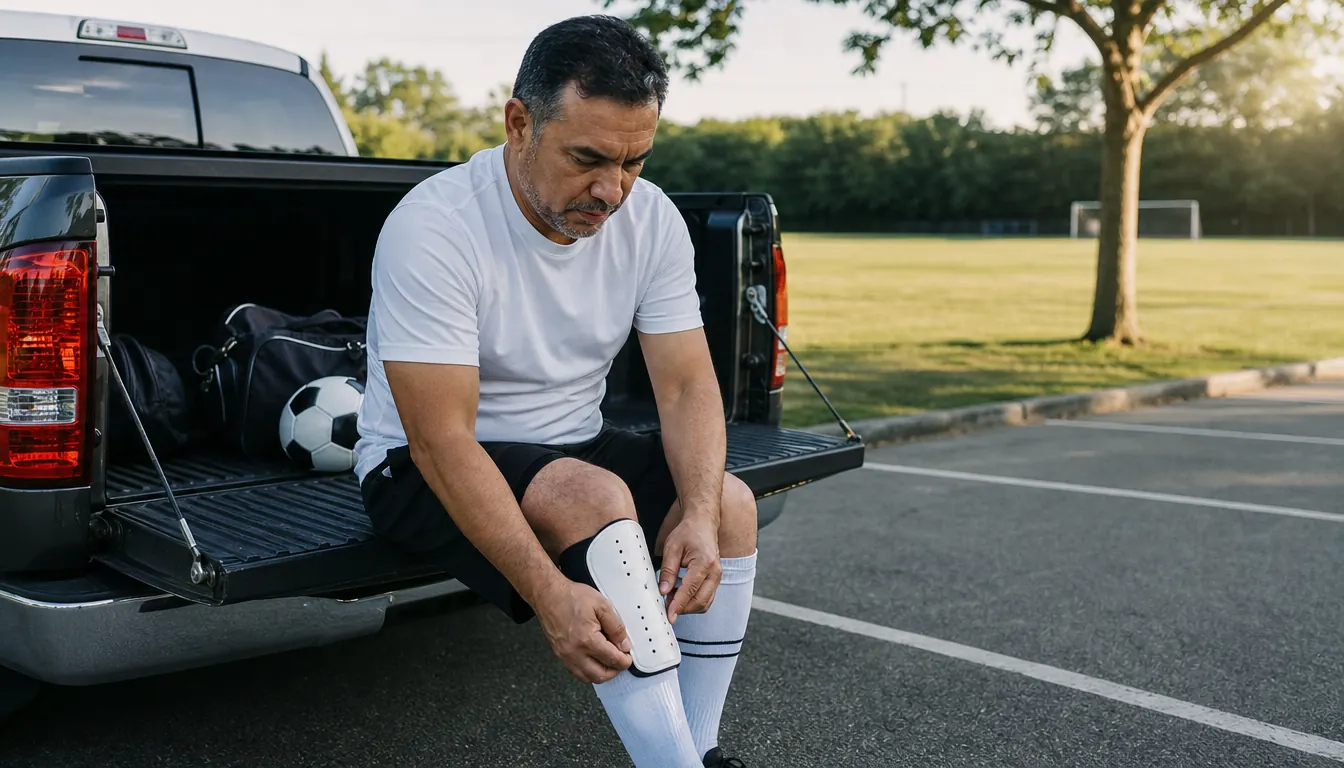
Two years ago the shield on my old hard-shell shin guards cracked straight across the middle, about four inches up from the ankle, during a Sunday morning over-40 game. I finished the half, drove to a sporting goods store still in my kit, and walked out with a pair of Franklin Sports Superlight shin guards in size Large. I am 48. I play center midfield on grass every Sunday and 7-a-side on artificial turf every Wednesday, and I have been strapping on shin guards for about twenty years. This is the honest version of how that pair has held up, including the two things about them that annoy me and the sizing confusion the listing does not clear up.
Most shin guard reviews get written in the first week, while everything still looks new and the straps still stick. This one gets written after two years of weekly games, a hundred or so washes of the socks that go over them, and one cold January morning where I seriously considered staying in bed. I bought a second pair for my son Gabe about a year ago, so I have watched two pairs age at different rates. I am not going to tell you these are the best shin guards ever made. I am going to tell you what they are genuinely good at, and where an adult needs to pay attention before ordering.
The Quick Verdict
Light, comfortable under a sock, and honest about being foam and plastic. The shield holds up fine. The straps are the part that ages, and the size guidance is written around kids, so adults have to size up on purpose.
Amazon Check Today's Price →The Shield Is Fine. Check Your Size Before You Order.
I wear a Large at 5 foot 10. The Medium variant is graded to 5 foot 3 and ages 6 to 12, so read the size line on the option you actually pick.
Amazon Check Today's Price on Amazon →How I Have Actually Used Them
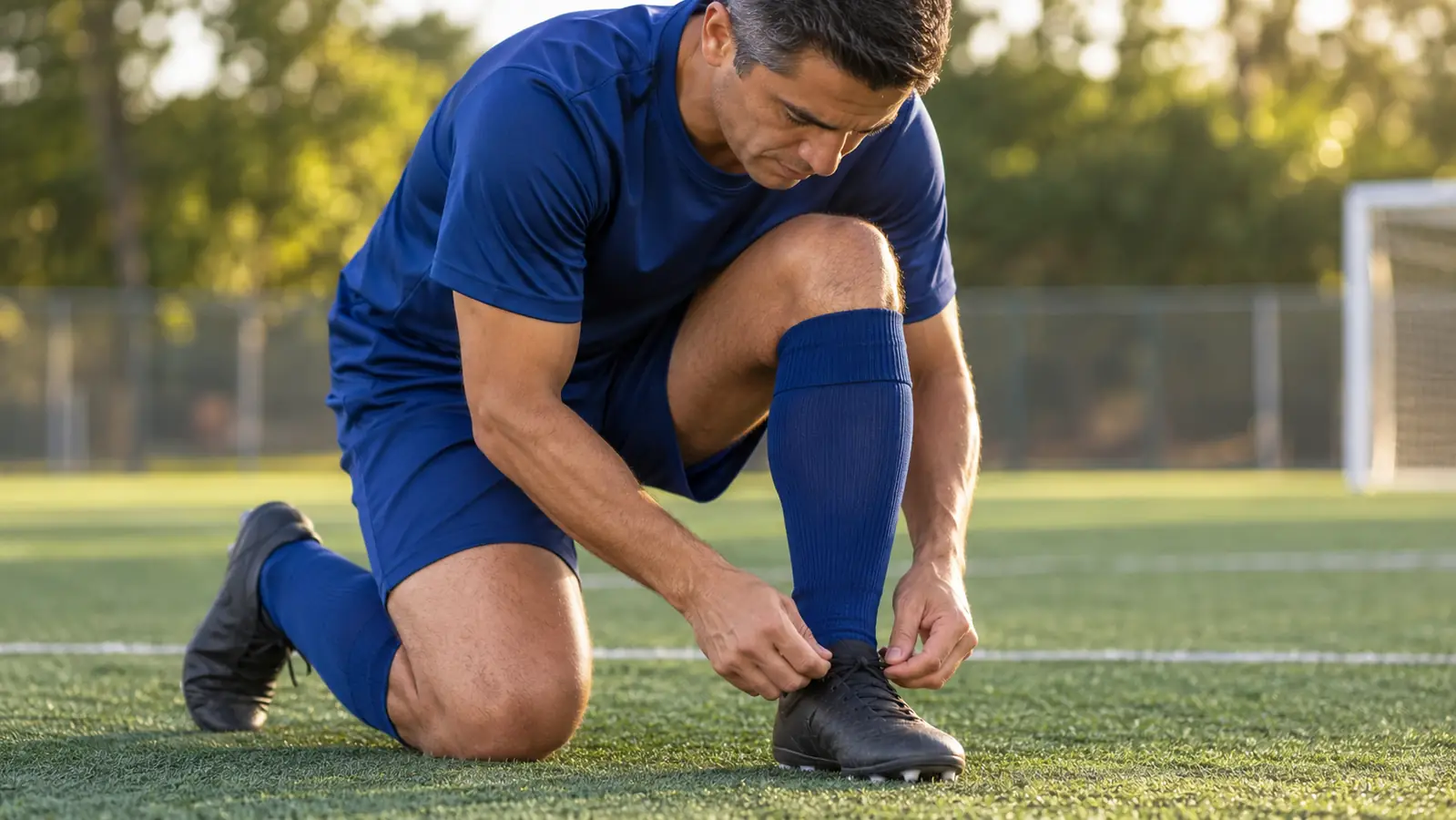
My pattern is boring, which is the point. Sunday league, 11-a-side, grass at a city park, usually 70 minutes for me plus warm-up. Wednesday, 7-a-side on turf, shorter but faster, with more contact around the ankles. I wear the Franklin pair under my team socks for both. They come out of the bag, go on over bare shins, the two straps pull across the back of the calf, and the socks go over the top. Maybe forty seconds per leg once you have done it a few times.
The pair weighs 0.14 kg according to the listing, which is close enough to what my kitchen scale says, and the shield measures 11 inches long and 5 inches wide. On my leg that covers from just above the ankle to a couple of inches below the knee, which is exactly where I get kicked. I have taken studs across the front of the shin twice in two years. The first was in a September cup game against a team about ten years younger than ours, a winger who came in late and high, and I felt it for two days. The second was a Wednesday night on the turf, studs down the front of the shield from a kid half my age sliding in. Both times it was a sting and a bruise and I kept playing, which is all I ask of a shin guard.
What I have not done is wear them for anything else. No refereeing, no coaching, no gym. They live in the black backpack soccer bag that rides in the back of my work truck all week, which means they bake in a Texas truck cab from May through September and freeze in January. August is the real test. It is 103 degrees outside and closer to 130 in that cab, and the straps come out feeling soft and slightly tacky, like the adhesive has gone slack. They stiffen back up overnight in the garage. Not once have they warped, cracked, or taken a permanent bend. That is more than I can say for the pair they replaced.
The Sizing Is the Part Nobody Explains
Here is what would have saved me ten minutes in the store. This listing covers youth and adult sizes in one place, and the size guidance is written variant by variant. The Medium is graded as up to 5 foot 3 and ages 6 to 12. I am 5 foot 10 and about 185 pounds. There is nothing wrong with that chart, but it reads like a kids chart, and if you skim it you will order a Medium thinking it means adult medium and wonder why a guard the length of your hand showed up.
So I wear a Large, and I got there by process of elimination rather than by trusting the chart at a glance. What I did in the store, standing in the aisle in a sweaty kit, was hold the Medium up against my shin first. It reached from my ankle to maybe six inches up, leaving a hand's width of bare shin below the knee. That is the spot I get studded most often. I put it back and took the Large. If you are an adult buying these, read the size line on each option rather than the one the page shows by default. Gabe is 16 and plays high school varsity, and I bought him his own pair about a year ago. His sizing conversation was different again because he is still growing, and I sized his by having him stand up and measuring from the top of his ankle bone to the bottom of his knee. Two people in one house, two different sizes, one product.
One more note on the fit. The shield is symmetrical, so there is no left and no right. You can put either guard on either leg, which sounds trivial until you are digging them out of a bag in the dark at 7:40 on a Sunday morning. It also means one guard can wear faster than the other if you always grab the same one first, which I apparently do. My right guard is a full shade duller than my left one, and the strap on it started loosening months before the left one did.
How They Feel for Ninety Minutes
Light is the right word. The construction is lightweight and the shield is a thin, high density shell over a foam backing, so once your socks are up you mostly forget they are there. The chrome accent on the front is cosmetic and it scuffs, which I do not care about. What I do care about is whether the guard stays put when I turn. It does, provided the straps are tight enough, and that is a real proviso. Set them snug enough that the guard does not rotate and loose enough that your calf does not throb at the seventy minute mark. That window is narrow the first week and obvious after that.
In heat they get warm, because foam against skin under a sock is foam against skin under a sock. On the Wednesday turf game, with sweat running down my leg, the backing can slide a little before the strap catches it. I have never had one come off. I have had to re-pull a strap at halftime maybe half a dozen times in two years, and four of those were in July and August. That is the honest number, not a marketing number.
If you are used to a hard shell with ankle coverage attached, these will feel like less. They are a slip-in shield and a strap system, nothing else. I switched because my old pair cracked and because I wanted something lighter on a right ankle I rolled badly about six years ago, and I got both of those things. I also gave up the ankle wings, and I have not missed them.
The Straps Do More Work Than the Shield
The double adjustable self-stick straps decide whether you like these guards. Two straps, one above the calf and one below, each with its own hook and loop closure that pulls through and sticks back on itself. Set them once and they hold. After two years I can tell you the shield is not the weak point. The straps are.
After about eighteen months, the upper strap on my right guard started letting go once or twice a game. Not falling off, just loosening enough that I noticed and re-pulled it. The hook side had picked up lint and grass and the loop had stretched. I cleaned the hooks out with a fingernail, which bought me a few more months, and then I stopped worrying about it because I was going to finish the season in them either way. What I would do differently is wash them. I never did, not once in two years, because it never occurred to me that a shin guard could be washed. A teammate pointed out that a quick hand wash with the hooks pressed shut would have kept the grip alive longer. That is on me, not on Franklin, and it is the one maintenance tip I would pass along to anyone buying a pair.
The lesson is not that the straps are bad. It is that a pull-on closure with self-stick adjustment is a wear item, and the warranty here is 90 days limited. Do not expect a two-year strap on a 90-day warranty. Expect to replace the pair every couple of seasons, which is roughly what I have always done with shin guards, and keep a spare set in the bag if you play twice a week like I do.
What Two Years of Sundays Did to Them
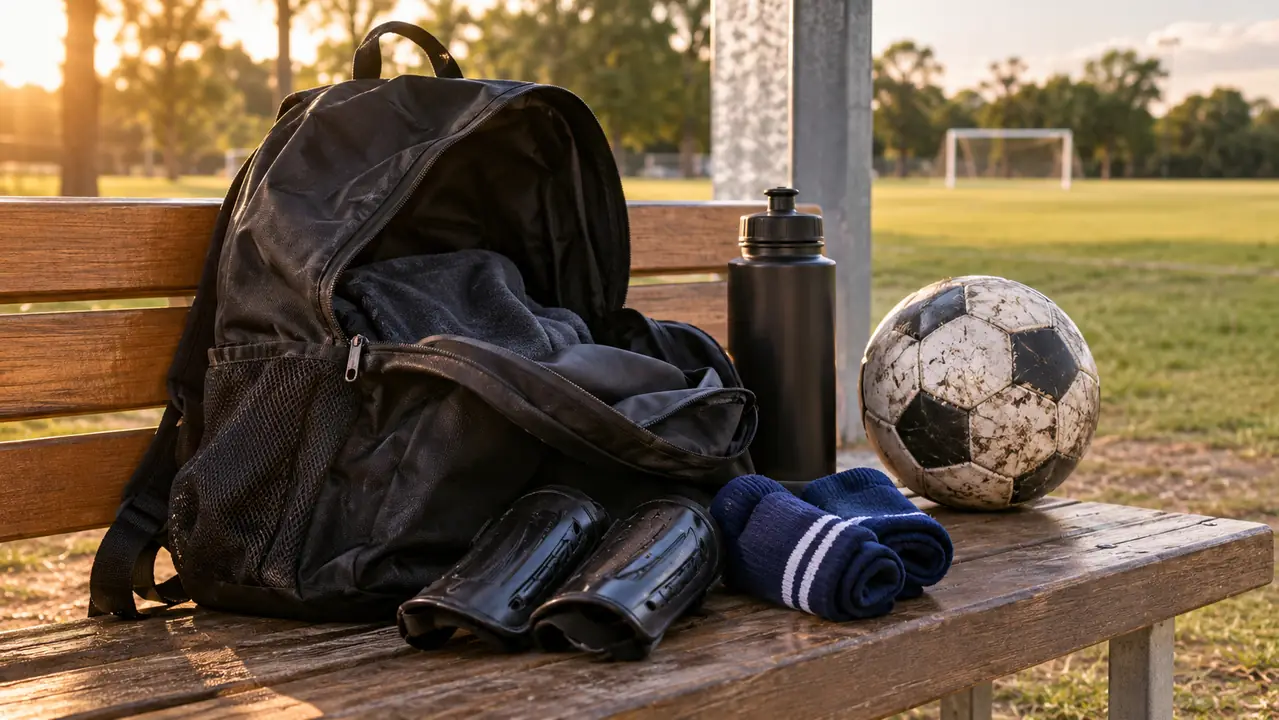
The shield has scuffs and a dull patch where the chrome used to be. The foam backing has compressed slightly on the front of both guards, mostly where I take contact. The straps have lost some grip. Nothing has cracked, nothing has delaminated, and nothing has poked through into my sock. For something that lives in a hot truck and gets kicked for a living, that counts as a good result in my book.
I keep a rough log of games, mostly so I stop arguing with myself about whether I am playing too much. Two years of it works out to something like 95 Sunday league matches, since we take summers off in July and the league skips holiday weekends, plus around 70 Wednesday pickup nights when the turf is not booked out. Call it 165 games on one pair. Of those, maybe 60 were on the turf, and the turf nights are the ones that chewed the straps. If I had played only grass, I suspect the straps would still be holding.
The pair I bought Gabe about a year ago is in better shape than mine, which tells you the wear is about volume and not about time. He plays high school ball in season, so his guards see fewer games per month than mine see year round. If you play once a week, expect these to look new for a long while. If you play twice a week on turf, expect the straps to go first, exactly like mine did.
Would I buy them again? Yes, and I will, probably this winter when the upper strap finally gives out for good. I am not going to pretend I have tested every shin guard on the market, because I have not. I have tested this pair for two years, twice a week, and I know what it does and does not do.
What I Liked
- Genuinely light at 0.14 kg for the pair, and you stop noticing them once your socks are up
- Symmetrical shield, so there is no left or right to sort out in a bag before a 7:40 kickoff
- The high density shield took two hard studs in two years without cracking or passing the hit through
- Double self-stick straps hold a set position through a full 90 minutes while they are new
- Easy to justify replacing every couple of seasons, because that is what it is built to be
Where It Falls Short
- Size guidance is graded around youth, so adults have to read each variant and size up deliberately
- The self-stick straps lose grip after roughly eighteen months of twice-weekly play
- Foam backing gets warm and can slide under sweat before the strap catches it
- 90 day limited warranty, which does not cover the part that actually wears out
- No ankle coverage at all, so if you want wings or a disc this is not that product
Nothing has cracked, nothing has delaminated, and nothing has poked through into my sock. The shield is not the weak point. The straps are.
Who This Is For
Adult rec players who want a light slip-in shield under their team socks and do not need ankle coverage. If you play once or twice a week on grass or turf, at a level where the contact is real but nobody is trying to hurt you, this is a sensible buy. It is also a fine first pair for a teenager, provided you get the size right. I would file it with the rest of the gear in my bag: nothing fancy, does the job, replace it when it wears.
It also suits anyone who, like me, is carrying an old ankle and wants less weight down there. That is a comfort preference, not a medical claim. My right ankle is the one I rolled badly about six years ago and rehabbed with a physical therapist, and lighter gear on that leg is simply easier for me on a Wednesday night. If something actually hurts, see a doctor or a physical therapist. Gear does not fix a joint.
Who Should Skip It
Skip these if you want ankle coverage built in. There is no disc, no wing, nothing below the shield. If you play in a league where tackles come in low and you have had ankle trouble, look at a guard with coverage or keep wearing whatever brace you already trust. I wear a lace-up brace on my right ankle for exactly that reason, and it is doing a different job than the shin guard is.
Skip them if you will not read a size chart. This listing runs from kids to adults in one place and the guidance on the Medium is written for a 5 foot 3 twelve-year-old. An adult who orders the default size gets a guard that does not cover what it should. And skip them if you want one pair to last five years. The straps are a wear item, and mine started letting go after about eighteen months of twice-weekly play.
Two Years In, I Would Buy Them Again. Just Get the Size Right.
I wear a Large at 5 foot 10. Read the size line on the variant you choose, not the one the page shows by default, and keep a spare set in the bag if you play twice a week.
Amazon Check Today's Price on Amazon →